Lara Kajs
Dispatches from the Field — The Genocide Report
Washington, DC — 16 September 2025
The UN Commission of Inquiry on Gaza has released a report assessing Israel’s military actions in Gaza through the lens of international law, including potential genocide. Drawing on field investigations, witness testimony, and digital evidence, the report highlights widespread civilian casualties, mass displacement, and restrictions on humanitarian aid. While not legally binding, the findings underscore the legal, political, and humanitarian stakes for accountability mechanisms and the international community, raising urgent questions about both the protection of civilians and the enforcement of international norms.
A report by the UN Commission of Inquiry (COI) concludes that Israel’s actions in Gaza may amount to genocide. The report builds on two years of investigation into violence and human rights violations in Gaza, Israel, and the West Bank, with particular focus on developments following the escalation of hostilities in October 2023.
Drawing on eyewitness testimony, field investigations, and digital evidence, the Commission presents findings it characterizes as direct and independently verified. Its conclusions have sparked significant international debate—not only over the legality of Israel’s military conduct, but also over how genocide is defined and applied in contemporary armed conflict.
The Commission’s Findings
Established in 2021, the Commission was mandated to investigate alleged violations of international law in the region. Its latest report identifies several areas of concern that, taken together, it argues could meet the legal threshold for genocidal conduct.
Mass Civilian Harm and Targeting Concerns
The report documents extensive civilian casualties resulting from Israeli military operations. According to the Commission, airstrikes in densely populated areas—including residential neighborhoods, hospitals, schools, and places of worship—raise serious concerns under the principle of distinction, a cornerstone of international humanitarian law.
The scale of destruction and loss of life described in the report has had profound humanitarian consequences, particularly for children, who face long-term physical and psychological trauma.
Collective Punishment and Displacement
The Commission further assesses that widespread destruction of civilian infrastructure and mass displacement may constitute collective punishment, which is prohibited under international law. These actions, it argues, appear not solely incidental to military objectives but part of broader operational patterns with severe civilian impact.
Intent and the Legal Threshold for Genocide
A central issue in the report is whether there is sufficient evidence of intent to destroy, in whole or in part, a protected group—a key requirement under the Genocide Convention.
The Commission points to official statements, patterns of conduct, and the cumulative effect of military and administrative measures as indicators that could support an inference of such intent. It concludes that these factors warrant serious consideration under the legal framework governing genocide, while acknowledging that definitive legal determination ultimately rests with judicial bodies.
Denial of Access to Humanitarian Aid
The report also highlights severe limitations on humanitarian aid entering Gaza. Restrictions on food, medical supplies, and essential services have contributed to a deepening humanitarian crisis. The Commission argues that such conditions may reinforce claims that civilian suffering is being used as a tool of war.
The Commission’s report places renewed emphasis on accountability and the adherence to international law, highlighting the urgent need to protect civilians amid escalating violence.”
Legal and Political Significance
The Commission’s findings are significant in that they elevate the legal characterization of the conflict, explicitly raising the question of genocide. While the report itself is not legally binding, it increases pressure on institutions such as the International Criminal Court (ICC) and other international mechanisms to assess potential accountability.
At the same time, the report underscores the difficulty of applying legal categories like genocide in active conflict environments, where evidence, competing narratives, and political interests often collide.
Israel’s Response and International Reactions
Israel has rejected the Commission’s findings, describing the report as biased and politically motivated. Israeli officials maintain that military operations are conducted in self-defense against Hamas and emphasize the operational challenges posed by combat in densely populated areas.
International reactions have been sharply divided. Organizations such as Amnesty International and Human Rights Watch, and The Genocide Report have called for further investigation and accountability, while key allies—including the United States—have criticized or dismissed the report’s conclusions, and reiterated Israel’s right to self-defense.
Broader Implications for International Justice
The report carries significant implications for international law and the future of the Israeli–Palestinian conflict. Allegations of genocide carry not only legal consequences but also profound political weight, influencing diplomatic relations, potential sanctions, and the broader legitimacy of state actions.
At the same time, efforts to pursue accountability may complicate already fragile diplomatic processes. The tension between justice and stability remains a defining challenge in responding to mass atrocity allegations.
A Deeply Divisive Issue
The Commission’s report represents a critical moment in ongoing efforts to document and assess alleged violations in Gaza. While it does not constitute a final legal judgment, it places renewed emphasis on the need for accountability, transparency, and adherence to international law.
As debate continues, a central question remains unresolved: whether the international community is willing—or able—to act decisively in response to such findings. The answer will shape not only the future of Gaza, but also the credibility of the international system tasked with preventing and responding to mass atrocities.
Atrocity Prevention Lens
Escalating violence in densely populated areas significantly increases the risk of large-scale civilian harm and long-term societal trauma. Analysts working in atrocity prevention often view patterns such as widespread civilian casualties, mass displacement, and restrictions on humanitarian aid as warning indicators that the risk of mass atrocity crimes may be increasing. Monitoring these indicators and strengthening international accountability mechanisms remain essential components of preventing further escalation and protecting civilian populations.
Legal Framework
Genocide Convention
The 1948 Genocide Convention defines genocide as specific acts committed with the intent to destroy, in whole or in part, a national, ethnic, racial, or religious group. Establishing genocidal intent remains one of the most complex evidentiary challenges in international criminal law.
International Humanitarian Law
During armed conflict, international humanitarian law—including the Geneva Conventions—requires parties to distinguish between civilian objects and military targets and prohibits attacks expected to cause disproportionate civilian harm.
Collective Punishment
International law prohibits collective punishment against civilian populations. Actions that deliberately impose suffering on civilians as a means of warfare may constitute violations of international humanitarian law.
International Criminal Accountability
Institutions such as the International Criminal Court may investigate and prosecute individuals responsible for war crimes, crimes against humanity, or genocide when jurisdictional requirements are met.
Suggested Citation
Kajs, Lara. “Genocide Determination and the UN Commission of Inquiry on Gaza.” Dispatches from the Field.
The Genocide Report, Washington, DC, 16 September 2025.
Photo Credit
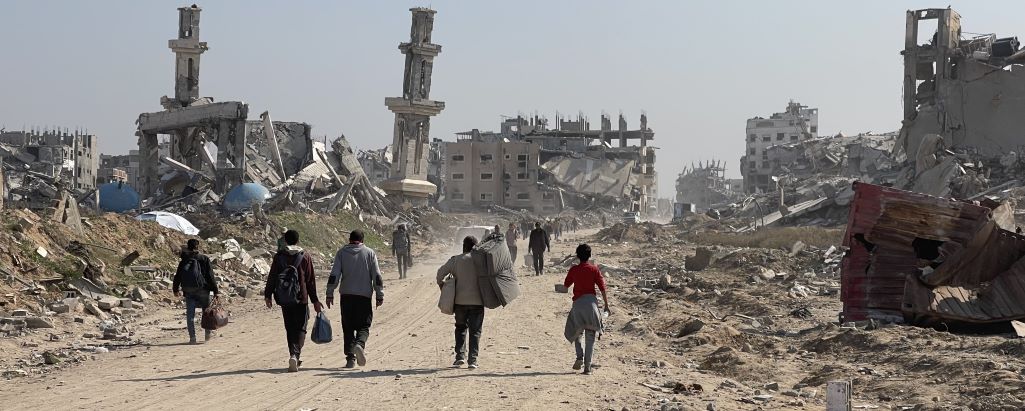
Forced displacement of Gaza Strip residents during the Gaza-Israel war 23-25 by Jaber Badwan. Licensed under CC BY-SA 4.0.
About TGR
The Genocide Report (TGR) publishes analysis and educational resources on conflict, international law, and atrocity prevention. Its work seeks to bridge academic research, field realities, and public understanding of mass violence and civilian protection.
About the Author
Lara Kajs is the founder and executive director of The Genocide Report, a Washington, DC-based educational nonprofit focused on atrocity prevention and international law. She is the author of several field-based books on conflict, displacement, humanitarian crises, and international humanitarian law, drawing on extensive research and field experience in Yemen, Syria, and Afghanistan. Her writing and public speaking focus on atrocity crimes, forced displacement, the protection of civilians, and the legal frameworks governing armed conflict.