By Lara Kajs
Dispatches from the Field—The Genocide Report
Washington, DC — 13 January 2026
Protests erupted in Tehran on 28 December 2025 following the collapse of Iran’s national currency, with the rial plunging to approximately 1.24 million to one U.S. dollar. The unrest has unfolded amid soaring inflation—estimated at roughly 40 percent—chronic state mismanagement of essential services, including water access, and rapidly deteriorating living conditions. A recent increase in fuel prices further intensified public anger. Taken together, these conditions have triggered widespread unrest across Iran, reflecting deep structural grievances against an entrenched and ideologically rigid governing system that many citizens believe has failed to meet the population’s basic needs.
The protests began with strikes by vendors in Tehran’s Grand Bazaar and quickly expanded as merchants and shopkeepers across the city joined the demonstrations. As participation grew, so did the range of grievances. Demonstrations spread to universities and evolved into broader calls for political change, with protesters demanding human rights, dignity, and fundamental freedoms.
Participants represent a broad cross-section of Iranian society, including workers, students, ethnic minorities, women, and individuals affected by long-standing economic hardship and systemic repression. The unrest has since spread to more than 200 cities and towns across all 31 provinces, indicating a level of national mobilization rarely seen in recent years.
Criminalization of Protest
On 3 January 2026, Supreme Leader Ali Khamenei warned that protesters must be “put in their place.” Later that day, the Islamic Revolutionary Guard Corps (IRGC) declared that its period of “tolerance” had ended. The Head of the Judiciary instructed prosecutors to show no leniency toward protesters, organizers, or perceived leaders and to expedite prosecutions.
Authorities have increasingly framed the protests as a threat to national security, labeling demonstrators as “terrorists” and “enemies of God”—charges that can carry the death penalty under Iranian law. This legal characterization is being used to justify severe penalties not only against protesters but also against individuals accused of supporting or assisting them.
Use of Force and Mass Detention
Iranian security forces, including the IRGC and the national police force (FARAJA), have responded with widespread and often lethal force. Reports indicate the use of live ammunition, metal pellets fired from shotguns and rifles, tear gas, water cannons, and physical beatings to disperse protesters. IRGC officials have also warned that executions of detained individuals may begin imminently.
Authorities have arbitrarily detained tens of thousands of individuals, including children as young as eight. Many detainees are reportedly held without due process and often incommunicado, placing them at significant risk of torture, sexual violence, and other forms of ill-treatment. Reports of forced confessions—some broadcast on state television—raise serious concerns regarding coercion and violation of due process.
On 5 January, Tasnim News, which is affiliated with the IRGC, aired confessions from an 18-year-old woman and a 16-year-old girl accused of leading riots. Such broadcasts have historically been used by authorities to reinforce official narratives and deter dissent.
Security forces have also reportedly conducted nighttime raids on private homes and abducted individuals from hospitals. These actions may constitute serious violations of international law, including torture, enforced disappearance, and extrajudicial killing.
The current crackdown echoes the state response to the 2022 “Woman, Life, Freedom” protests, which followed the death of Jina Mahsa Amini after her arrest by Iran’s morality police. As in 2022, the response has been characterized by widespread human rights violations and systemic impunity.
Information Blackouts
On 8 January, Iranian authorities imposed widespread internet and mobile network shutdowns, severely restricting the ability of protesters and journalists to document and disseminate information. These blackouts function as a deliberate tool of repression, limiting transparency and obstructing international scrutiny.
Internet restrictions also interfere with basic rights to freedom of expression and access to information. Such measures have been widely documented in previous protest crackdowns in Iran and are frequently used to control narratives and suppress evidence of state violence.
Documented Incidents and Patterns
Accounts from witnesses, medical personnel, and reviewed visual evidence indicate repeated use of force against demonstrators in multiple regions. In several reported incidents, including in Lorestan and Kermanshah provinces, security forces allegedly opened fire on crowds. Verified footage reviewed by rights groups shows protesters fleeing amid gunfire, with casualties reported.
There are also reports of security forces entering medical facilities in search of injured protesters, raising concerns about the safety of patients and medical personnel and about interference with access to medical care.
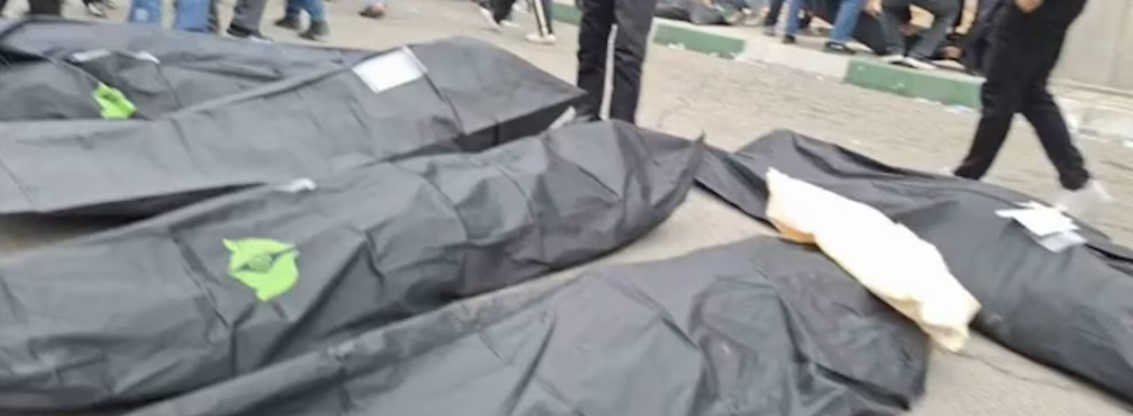
Current estimates suggest that at least 4,800 people may have been killed, although the true number is likely significantly higher. Nearly 20,000 individuals have reportedly been arbitrarily detained.
International Legal Concerns
The reported actions raise serious concerns under international human rights law. Iran is a party to the International Covenant on Civil and Political Rights (ICCPR), which protects the rights to freedom of assembly, expression, due process, and protection from torture.
The United Nations Independent Fact-Finding Mission on Iran has expressed concern over the reported use of force and mass detentions, calling for restraint, restoration of internet access, and the release of individuals detained for peaceful protest.
As the situation develops, sustained international attention, continued documentation, and support for accountability mechanisms will be essential to assessing violations and protecting the rights of those affected.
Photo Credit: Body bags outside the Kahrizak Forensic Medical Center in Tehran. (TGR File)
Atrocity Prevention Lens
Large-scale protest movements can become flashpoints for mass human rights violations when governments frame civilian dissent as a national security threat. Analysts working in atrocity prevention often view the criminalization of protest, widespread arbitrary detention, internet shutdowns, and the use of lethal force against demonstrators as warning indicators of escalating repression.
When such patterns occur alongside systemic impunity and the use of severe criminal charges against civilians, the risk of widespread abuses increases significantly. Monitoring state responses to civil unrest, documenting violations, and maintaining international scrutiny are essential to preventing further harm and protecting civilian populations.
Legal Framework
Freedom of Assembly and Expression
International human rights law protects the rights of individuals to peacefully assemble and express political views. Articles 19 and 21 of the International Covenant on Civil and Political Rights guarantee these freedoms, which may only be restricted under narrowly defined circumstances.
Protection from Arbitrary Detention
Article 9 of the ICCPR prohibits arbitrary arrest or detention and requires that individuals be informed of charges against them and brought promptly before a judicial authority.
Prohibition of Torture and Cruel Treatment
International law strictly prohibits torture and other forms of cruel, inhuman, or degrading treatment. This prohibition is absolute and applies regardless of political circumstances or internal unrest.
Protection of Civilians
Under international human rights law and customary international law, states must refrain from excessive use of force against civilians and ensure that security operations respect the principles of necessity and proportionality.
About TGR
The Genocide Report (TGR) publishes analysis and educational resources on conflict, international law, and atrocity prevention. Its work seeks to bridge academic research, field realities, and public understanding of mass violence and civilian protection.
Lara Kajs is the founder and executive director of The Genocide Report, a Washington, DC-based educational nonprofit focused on atrocity prevention and international law. She is the author of several field-based books on conflict, displacement, humanitarian crises, and international humanitarian law, drawing on extensive research and field experience in Yemen, Syria, and Afghanistan. Her writing and public speaking focus on atrocity crimes, forced displacement, the protection of civilians, and the legal frameworks governing armed conflict.