Dispatches from the Field — The Genocide Report
Washington, DC — 23 December 2021
The military coup in Myanmar represents a collapse of constitutional governance, followed by systematic violence against civilians and the erosion of legal protections.
On 1 February 2021, Myanmar’s military seized power, detaining elected leaders and preventing the formation of a civilian government following national elections. The coup marked a decisive reversal of the country’s limited democratic transition and initiated a period of sustained instability and violence.
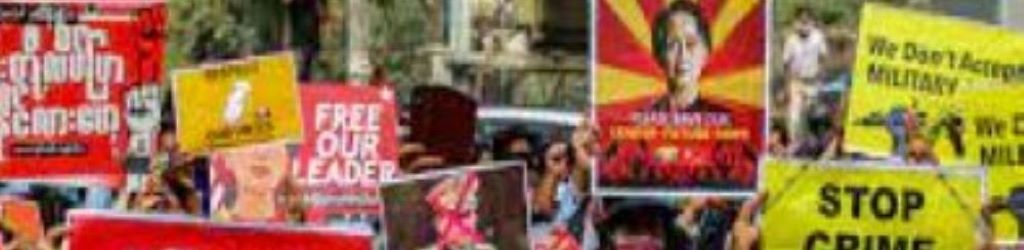
In the months that followed, widespread protests emerged across urban and rural areas. Initially nonviolent, these demonstrations were met with escalating force by military authorities. As repression intensified, the situation evolved into a broader conflict involving both civilian resistance groups and ethnic armed organizations.
Escalation of State Violence
The military response to dissent has been characterized by the use of lethal force against civilians. Security forces have targeted demonstrators, conducted raids in residential areas, and deployed heavy weapons in populated regions.
Mass casualty incidents have been documented in multiple locations. In March 2021, large-scale killings of demonstrators were reported in Yangon. Similar patterns followed in other regions, including Bago, where security forces used sustained lethal force against civilians.
In rural areas, particularly in the northwest, military operations have included village raids, shelling, and arbitrary detention. Reports from December 2021 describe the killing of civilians in Done Taw village, including acts of torture and execution. Such incidents reflect patterns of violence intended to deter resistance and assert control.
In addition to physical violence, the junta has expanded efforts to suppress dissent through intimidation and legal pressure. Lists of journalists, academics, and activists have been published, with individuals charged under broadly defined offenses related to state stability. These actions contribute to a climate of fear and restrict the flow of information.
Collapse of the Rule of Law
The coup disrupted constitutional governance and undermined legal institutions. Elected officials, including State Counsellor Aung San Suu Kyi and President Win Myint, were detained, and the military declared itself the governing authority.
Claims of electoral fraud were cited as justification for the takeover, despite a lack of substantiated evidence from independent observers. Subsequent legal proceedings against detained officials, including convictions on charges related to incitement and public health violations, have raised concerns regarding due process and judicial independence.
These developments reflect a broader erosion of the rule of law, in which legal systems are used to legitimize political control rather than uphold rights and accountability.
The breakdown of rule of law in Myanmar reflects not only a seizure of power, but the institutionalization of violence as a tool of governance.”
International Legal Implications
The conduct of military authorities has raised significant concerns under international law. The use of lethal force against civilians, arbitrary detention, torture, and extrajudicial killings may constitute violations of international human rights law and international humanitarian law.
Patterns of widespread or systematic attacks against civilian populations may meet the threshold for crimes against humanity. Ongoing monitoring and documentation efforts are critical to assessing the full scope of violations and supporting future accountability mechanisms.
International organizations, including the United Nations, have called for the protection of civilians and the release of those arbitrarily detained.
International Response and Sanctions
In response to the coup and subsequent violence, several countries, including the United States, the United Kingdom, and Canada, imposed targeted sanctions on Myanmar’s military leadership and affiliated entities.
These measures have focused on limiting access to financial resources and restricting entities linked to military operations, including defense production. Sanctions are intended to impose economic and political costs while signaling international condemnation.
However, the effectiveness of sanctions remains contingent on coordination and enforcement. While they can constrain resources and increase pressure, their ability to alter behavior depends on broader geopolitical dynamics and the availability of alternative partnerships.
Conflict Dynamics and Escalation Risks
The situation in Myanmar has evolved beyond a political crisis into a complex and fragmented conflict. Armed resistance has expanded, and clashes between military forces and ethnic armed organizations have intensified, particularly in border regions.
This shift increases the risk of prolonged instability and further civilian harm. The combination of state repression, armed resistance, and limited international intervention creates conditions in which violence may continue to escalate.
Atrocity Prevention Lens
Myanmar demonstrates how the breakdown of democratic institutions and legal safeguards can rapidly increase the risk of atrocity crimes. Early indicators—including the detention of political leaders, suppression of dissent, and use of force against civilians—were followed by patterns of widespread violence. Strengthening early response mechanisms, supporting documentation efforts, and applying coordinated diplomatic and economic pressure are essential to mitigating further escalation.
Legal Framework
International Human Rights Law
Protects fundamental freedoms, including the rights to life, expression, assembly, and due process.
International Humanitarian Law
Applies in situations of armed conflict, prohibiting attacks on civilians and regulating the conduct of hostilities.
Rome Statute of the International Criminal Court
Defines crimes against humanity and war crimes, providing a legal basis for accountability where jurisdiction applies.
UN Charter
Mandates the international community to promote peace and security, including responses to threats arising from internal conflicts.
Suggested Citation
“Breakdown of Rule of Law in Myanmar.” Dispatches from the Field. The Genocide Report, Washington, DC, 23 December 2021.
Photo Credit
Yangon, Myanmar Peaceful Protest Against Coup – License by CC. 4.0 International License
About TGR
The Genocide Report (TGR) publishes analysis and educational resources on conflict, international law, and atrocity prevention. Its work seeks to bridge academic research, field realities, and public understanding of mass violence and civilian protection.