TGR
Dispatches from the Field — The Genocide Report
Washington, DC — 15 January 2015
By early 2015, Nigeria faced a rapidly escalating insurgency driven by Boko Haram, an armed Islamist militant group whose campaign of violence has destabilized large parts of the country’s northeast. What began as a localized extremist movement evolved into a sustained campaign marked by mass atrocities, territorial control, and systematic targeting of civilians. The group’s activities have not only created a severe humanitarian crisis but have also raised broader concerns regarding regional security, governance capacity, and the protection of civilian populations.
Origins and Escalation of the Insurgency
Boko Haram was founded in 2002 with an ideological platform opposing Western education and influence. Following the extrajudicial killing of its founder by Nigerian security forces in 2009, the group re-emerged under the leadership of Abubakar Shekau with increased militancy and organizational capacity.
Since that time, Boko Haram has conducted a sustained insurgency across northern Nigeria, employing tactics that include bombings, abductions, and targeted killings. While initially reliant on guerrilla warfare, the group expanded its operations to include more coordinated and overt attacks on towns and civilian populations, reflecting a shift toward territorial ambition and governance disruption. Its stated objective remains the establishment of an Islamic caliphate, achieved through the systematic erosion of state authority.
Boko Haram’s campaign reflects a deliberate strategy of targeting civilians to destabilize the state and assert territorial control through fear and violence.”
The Chibok Abductions and Global Attention
On 14 April 2014, Boko Haram abducted 234 schoolgirls from Chibok, an event that drew international condemnation and sparked the global #BringBackOurGirls campaign. The victims, primarily between the ages of 16 and 18, were targeted in part due to the group’s opposition to Western education.
Subsequent reports indicated that many of the abducted girls were subjected to forced marriage, sexual violence, and trafficking. The incident underscored the group’s deliberate use of gender-based violence as both a tactic of terror and a mechanism of control.
Escalation of Terrorist Attacks
Throughout late 2014 and early 2015, Boko Haram intensified its attacks against civilian targets. Suicide bombings in markets and places of worship resulted in significant casualties, including attacks in Maiduguri and Kano that killed dozens of civilians.
Particularly concerning was the increasing use of children in these operations. Reports documented instances in which young girls were coerced or forced to carry explosive devices into crowded areas. These acts highlight the extent to which the group exploits vulnerable populations, transforming victims into instruments of violence.
The Baga Massacre and Campaign of Violence
In early January 2015, Boko Haram launched a large-scale assault on the towns of Baga and Doron Baga, sustaining attacks over several days. Satellite imagery later revealed widespread destruction, with thousands of structures damaged or destroyed. Estimates suggest that as many as 2,000 civilians may have been killed, making it one of the deadliest incidents associated with the insurgency.
Eyewitness accounts described the indiscriminate targeting of civilians attempting to flee, including women and children. The scale and brutality of the attack reflect a pattern of violence intended to depopulate areas, assert control, and instill fear among remaining populations.
Humanitarian and Security Implications
The ongoing violence has resulted in widespread displacement, with civilians fleeing affected regions in search of safety. The humanitarian impact extends beyond immediate casualties, contributing to food insecurity, economic disruption, and limited access to essential services.
At the same time, Boko Haram’s activities pose a broader threat to regional stability, with cross-border implications for neighboring countries. The persistence of the insurgency highlights challenges related to governance, security coordination, and the capacity to protect civilian populations effectively.
Atrocity Prevention Lens
The patterns of violence associated with Boko Haram demonstrate clear indicators of atrocity crimes, including the systematic targeting of civilians, widespread use of sexual violence, forced recruitment of children, and large-scale destruction of communities. These acts reflect both intent and capacity to commit mass atrocities. Prevention strategies must prioritize strengthened civilian protection measures, enhanced regional security cooperation, and sustained international support for counterinsurgency efforts that adhere to human rights standards. Addressing underlying drivers, including governance deficits and socioeconomic marginalization, remains essential to reducing long-term risk.
Legal Framework
International Humanitarian Law
The actions of Boko Haram, including deliberate attacks on civilians, the use of child soldiers, and the destruction of civilian infrastructure, constitute serious violations of international humanitarian law. Under the Geneva Conventions and customary international law, such acts are prohibited and may amount to war crimes.
International Criminal Law
The scale and nature of abuses, including murder, enslavement, sexual violence, and persecution, may rise to the level of crimes against humanity. Accountability mechanisms, including potential investigation under the Rome Statute framework, are critical to addressing impunity and deterring future violations.
Suggested Citation
TGR. “Terrorism in Nigeria: Boko Haram’s Insurgency and the Escalation of Violence Against Civilians.” Dispatches from the Field. The Genocide Report, Washington, DC, 15 January 2015.
Photo Credit
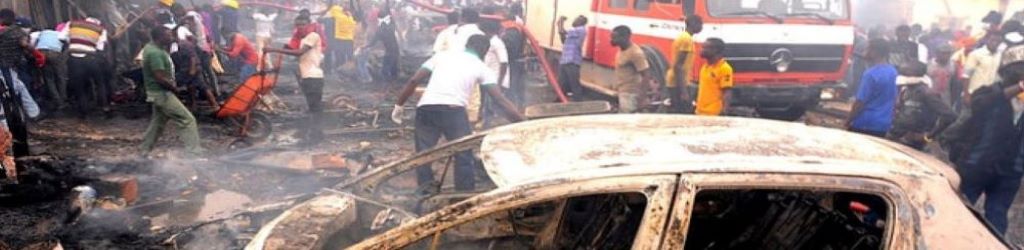
Boko Haram bombing by The Global Panorama. Licensed under CC 2.0.
About TGR
The Genocide Report (TGR) publishes analysis and educational resources on conflict, international law, and atrocity prevention. Its work seeks to bridge academic research, field realities, and public understanding of mass violence and civilian protection.