Dispatches from the Field—The Genocide Report
Washington, DC.—10 September 2025
The International Criminal Court (ICC) has initiated a historic “Confirmation of Charges” hearing against Joseph Kony, leader of the Lord’s Resistance Army (LRA), in his absence. This hearing assesses whether there is sufficient evidence to move forward with a trial for crimes against humanity and war crimes, including murder, abduction, and sexual enslavement of children and women across Uganda, the Democratic Republic of Congo, South Sudan, and the Central African Republic. The proceedings underscore both the possibilities and limitations of international justice in holding perpetrators of mass atrocities accountable.
The International Criminal Court (ICC) has taken the unprecedented step of opening a “Confirmation of Charges” hearing in the absence of the fugitive, Joseph Kony. The historic ICC hearing underscores both the enduring pursuit of accountability and ending impunity for the world’s worst crimes, and the challenges of international justice when defendants evade capture.
Rome Statute guidelines stipulate that the hearing’s sole function is to assess whether there is sufficient evidence to establish “substantial grounds” to believe the accused committed the alleged crimes, before potentially moving to trial. The Rome Statute prohibits the accused from being tried in absentia. For the victims and survivors to get the justice they deserve, and for Kony to be held accountable, he must be present to stand trial.
Wanted for War Crimes
Joseph Kony, Ugandan leader of the Lord’s Resistance Army (LRA), terrorized Central Africa for more than three decades. The LRA was designated a terrorist group by the UN, EU, and other governments, including the US and the UK.
Kony faces 39 counts of war crimes and crimes against humanity, including murder, rape, sexual slavery, torture, forced enlistment of child soldiers, and pillaging across Uganda, the Democratic Republic of Congo (DRC), South Sudan, and the Central African Republic (CAR). In addition to the abduction of 60,000 children, Kony is accused of more than 100,000 deaths, the displacement of 2 million people in Uganda alone, and horrifying survivor testimonies of forced cannibalism and other acts.
Kony and the Lord’s Resistance Army became infamous for their brutality. The LRA is estimated to have abducted over 60,000 children. One of its most heinous practices was the widespread use of child soldiers. The boys were often required to kill friends, family members, or villagers as a means of indoctrination and control. Many were as young as 8 years old. These children were brainwashed, drugged, and subjected to horrific violence, becoming both victims and perpetrators of war crimes. Thousands of survivors still struggle with trauma, displacement, and the challenge of reintegration. Former child soldiers face stigma and psychological scars that endure long after the guns have fallen silent.
Joseph Kony’s legacy is one of unimaginable suffering; bringing him to trial is essential not only for justice, but for the global fight against impunity.”
Sexual Enslavement
The defense counsel appointed to represent Kony in his absence argued that there should not be a distinction made between enslavement and sexual enslavement. However, is it possible to enslave someone and not inflict sexual acts against them? Most will agree that the answer is “yes.” So, if the answer is in the positive, then adding all enslavement, including sexual enslavement, to the same category as domestic slavery and labor slavery, diminishes the horrific abuse women and girls suffered at the hands of Kony and the LRA.
The victims and survivors of Joseph Kony were forced to have sex – they were repeatedly raped. Women and girls were not permitted to leave – they were enslaved. They were enslaved for sex. And worse still, they were enslaved to produce children for their captors.
Abducted women and girls were frequently enslaved and forced into “marriages” with commanders, where they endured sexual violence and exploitation. Kony believed that once a girl began her menstrual cycle, she was considered mature and ready to be a “wife”. According to ICC prosecutor Elise Pellet, Kony is believed to have as many as 90 “wives”, forced to have sexual intercourse with him on demand, and forced to bear his children. The expectation to bear children was for Kony, a way to create a new tribe, and said each girl was expected to have 15 children.
Women and girls were tortured and faced horrific violence for refusing to have sexual intercourse or other sex acts. They were beaten for breaking the LRA rules. They were beaten so badly that they could not eat or walk, for trying to escape.
Some women and girls were forced to beat other abducted women and girls. One girl was forced to carry the severed head of another abductee who tried to escape. One abducted girl was beaten severely. Then, she was told to remove her blouse, and with a hot machete, the sign of the cross was carved into her back. She was then forced to carry heavy supplies on her back.
Holding Kony Accountable
Joseph Kony remains a symbol of impunity and the enduring difficulty of achieving justice in the aftermath of mass atrocities. The warrant for his arrest remains active to this day, making him one of the ICC’s most wanted fugitives. However, capturing him has proven exceptionally difficult. The LRA’s guerrilla tactics and movement across remote and often inaccessible regions have made it nearly impossible for authorities to track him down.
The ICC’s determination to bring Kony to trial is commendable; it highlights both the potential and the limitations of international justice. While the court has successfully prosecuted other war criminals, it lacks the enforcement power to apprehend fugitives.
The Court relies on state cooperation, which is often inconsistent or politically complicated, to carry out arrests. These challenges also expose the need for stronger international cooperation, regional stability, and investment in justice systems. As the world continues to seek accountability for the crimes of the past, the case of Joseph Kony serves as a stark reminder: justice delayed must not become justice denied.
Joseph Kony’s legacy is one of unimaginable suffering. His crimes are a stark reminder of the human capacity for cruelty and the importance of international justice mechanisms. For many victims and advocates, justice will not be served until Kony is brought before the International Criminal Court to answer for his atrocities.
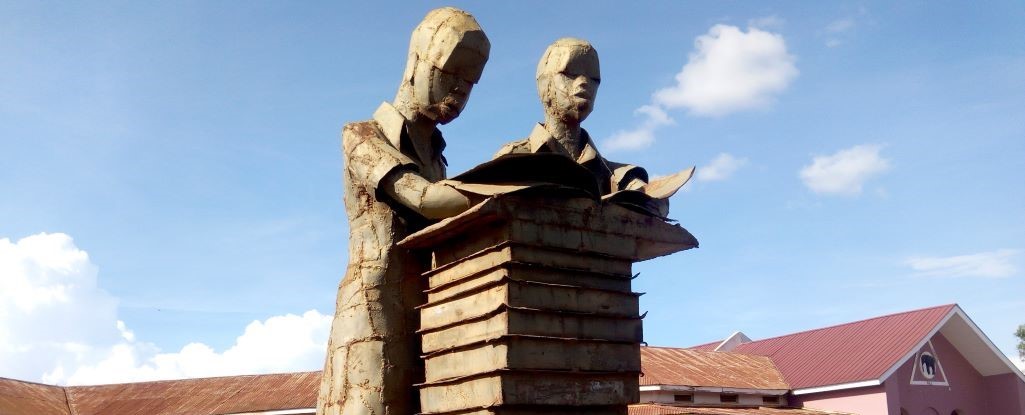
Photo Credit: Peace Monument in Gulu, Northern Uganda by Malaika Overcomer. Licensed under CC BY-SA 4.0
This metal peace monument was established in 2009 by the Dutch Embassy at the Gulu District Local Government headquarters. It depicts two children ( a female and a male) reading a book on top of a pile of 20 books. The monument was established in honor of the end of the 20-year war of the Lord’s Resistance Army led by Joseph Kony. There used to be guns laid at their feet, but they no longer exist. The guns that used to be laid at the feet of children show, “let’s put down firearms and focus on dialogue.”
Atrocity Prevention Lens
The case of Joseph Kony and the Lord’s Resistance Army reflects multiple high-risk indicators commonly associated with mass atrocity crimes, including the systematic targeting of civilians, widespread abduction of children, sexual violence, and forced displacement across multiple states. These patterns demonstrate how non-state armed groups can sustain prolonged campaigns of violence in regions with limited state capacity and weak enforcement mechanisms.
From an atrocity prevention perspective, the persistence of impunity remains a central concern. Kony’s continued evasion of arrest highlights the gap between international legal frameworks and enforcement, undermining deterrence and prolonging the suffering of affected communities. Effective prevention requires not only legal accountability but also sustained international cooperation, regional security coordination, and investment in post-conflict recovery and reintegration programs for survivors. Without these measures, conditions that enable such abuses may endure or re-emerge in other contexts.
Legal Framework
Rome Statute of the International Criminal Court
The Rome Statute establishes the legal framework for prosecuting genocide, crimes against humanity, and war crimes. The confirmation of charges hearing assesses whether there are “substantial grounds to believe” the accused committed the alleged crimes before proceeding to trial.
War Crimes
War crimes under the Rome Statute include serious violations of international humanitarian law, such as murder, torture, pillaging, and the conscription or use of child soldiers under the age of 15 in armed conflict.
Crimes Against Humanity
Crimes against humanity include widespread or systematic attacks directed against civilian populations. Acts such as murder, enslavement, sexual slavery, rape, and forced displacement fall within this category when committed as part of an organized campaign.
Child Soldiers
International law explicitly prohibits the recruitment and use of children in armed conflict. The conscription or enlistment of children under 15 years old is recognized as a war crime and a grave violation of international norms protecting children.
Sexual and Gender-Based Violence
Sexual slavery, forced marriage, and rape are prohibited under international law and may constitute both war crimes and crimes against humanity when committed in conflict settings.
State Cooperation and Arrest Obligations
The ICC relies on state cooperation to execute arrest warrants, as it does not have independent enforcement powers. The inability to apprehend fugitives like Joseph Kony highlights ongoing challenges in enforcing international criminal law.
About TGR
The Genocide Report (TGR) publishes analysis and educational resources on conflict, international law, and atrocity prevention. Its work seeks to bridge academic research, field realities, and public understanding of mass violence and civilian protection.