Dispatches from the Field — The Genocide Report
Washington, DC — 4 February 2021
Myanmar’s military coup marked an abrupt end to a fragile democratic transition and raised immediate concerns about repression, mass detention, and the risk of renewed atrocity crimes.
On 1 February 2021, Myanmar’s military seized control of the government hours before a newly elected parliament was set to convene. The takeover followed national elections in which Aung San Suu Kyi’s National League for Democracy (NLD) secured a decisive victory over the military-backed Union Solidarity and Development Party.
Military leaders justified the coup by alleging widespread electoral fraud. However, Myanmar’s election commission reported no evidence sufficient to support these claims. The military declared a state of emergency and transferred authority to Commander-in-Chief Min Aung Hlaing.
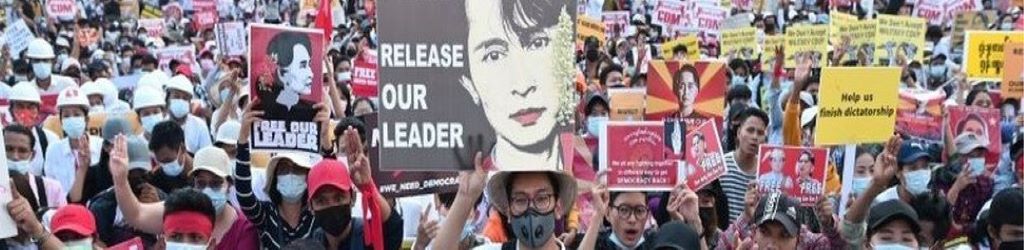
Senior political figures, including State Counsellor Aung San Suu Kyi and President Win Myint, were detained alongside lawmakers, journalists, and civil society actors. Communications disruptions, banking closures, and the presence of military forces in major cities signaled an immediate consolidation of control.
Democratic Reversal
The coup represents a significant reversal of Myanmar’s partial transition from military rule to civilian governance. After nearly five decades of military dictatorship beginning in 1962, reforms initiated in 2011 had allowed for limited political liberalization and electoral participation.
Despite these gains, the military retained substantial constitutional authority, including control over key ministries and a guaranteed share of parliamentary seats. The events of February 2021 underscore the fragility of that transition and the persistence of military influence within state institutions.
Early Indicators of Repression
The immediate aftermath of the coup revealed patterns commonly associated with democratic backsliding and authoritarian consolidation. Arbitrary detentions, restrictions on communication, and the targeting of political opponents and journalists point to a rapid erosion of civil liberties.
Such measures often serve as precursor indicators of broader state violence. The detention of political leadership, combined with efforts to control information and suppress dissent, increases the risk of escalation—particularly if met with public resistance.
The Rohingya Crisis in Context
The coup occurs against the backdrop of Myanmar’s ongoing Rohingya crisis, which remains one of the most significant human rights emergencies in recent history.
Investigations by the Office of the United Nations High Commissioner for Human Rights (OHCHR) have documented systematic discrimination against the Rohingya population, including restrictions on movement, denial of citizenship, and barriers to access in healthcare, education, and economic life.
Reports have also detailed patterns of arbitrary arrest, extortion, and targeted restrictions designed to marginalize the Rohingya community. These structural conditions contributed to mass displacement, with over one million Rohingya fleeing Myanmar following the military’s 2017 operations.
The continuation of military rule raises serious concerns regarding accountability for past abuses and the potential for further violations.
Aung San Suu Kyi and International Scrutiny
A central complexity in Myanmar’s political landscape is the role of Aung San Suu Kyi. Long regarded as a symbol of democratic resistance, her tenure in government was marked by widespread criticism over her response to the Rohingya crisis.
Under her leadership, Myanmar defended its actions before the International Court of Justice (ICJ) against allegations of genocide. Her government rejected key elements of international criticism and declined to recognize the Rohingya as a distinct ethnic group.
This dual legacy—democratic leadership alongside contested human rights positions—has shaped international reactions to her detention. While many governments have called for her release, criticism of her prior stance on the Rohingya remains a significant factor in global discourse.
International Response
The international community responded swiftly to the coup. Governments, including the United States under the Biden administration, condemned the military’s actions and called for the restoration of democratic governance and the release of detained leaders.
Statements emphasized support for the people of Myanmar and their democratic aspirations. At the same time, some policymakers and human rights advocates have highlighted the need to balance calls for democratic restoration with accountability for past human rights violations.
This tension reflects broader challenges in responding to crises in which democratic breakdown and unresolved atrocity allegations intersect.
Atrocity Prevention Lens
From an atrocity prevention perspective, Myanmar presents several early warning indicators: the unlawful seizure of power, detention of political leaders, suppression of dissent, and a history of mass atrocities against vulnerable populations.
These conditions elevate the risk of further violence, particularly if protests emerge and are met with force. Early international engagement—through diplomatic pressure, targeted sanctions, and support for monitoring mechanisms—will be critical in shaping the trajectory of the crisis.
Legal Framework
Constitutional Governance
The coup represents a rupture of constitutional order and the suspension of civilian authority.
International Human Rights Law
Protects against arbitrary detention, ensures freedom of expression and assembly, and guarantees due process.
Genocide Convention & ICJ Proceedings
Myanmar remains under international scrutiny for alleged violations related to the Rohingya, with ongoing legal proceedings at the International Court of Justice.
Responsibility to Protect (R2P)
Provides a framework for international action when a state is unwilling or unable to protect its population from mass atrocity crimes.
Suggested Citation
“A Coup in Myanmar.” Dispatches from the Field. The Genocide Report, Washington, DC, 4 February 2021.
Photo Credit
Peaceful Protest Resisting Coup – 4 February 2021 – Licensed by CC 4.0 International license
About TGR
The Genocide Report (TGR) publishes analysis and educational resources on conflict, international law, and atrocity prevention. Its work seeks to bridge academic research, field realities, and public understanding of mass violence and civilian protection.