Dispatches from the Field—The Genocide Report
Washington, DC.—30 September 2025
Eighty years after its founding, the United Nations continues to serve as the primary international framework for preventing conflict, promoting human rights, and addressing humanitarian crises. From peacekeeping missions in Sudan and Afghanistan to nuclear non-proliferation efforts, the UN operates at the intersection of law, diplomacy, and civilian protection. Despite structural limitations and political challenges, its role in mitigating violence and coordinating global responses remains central to contemporary atrocity prevention and international law enforcement.
The United Nations was established in 1945 from the ashes of the Second World War, as 50 member states came together to prevent humanity from repeating its darkest chapters. Signing the UN Charter in San Francisco on 26 June 1945, these leaders committed to upholding international peace and security, promoting human rights, and fostering social and economic development—a framework that remains essential eight decades later.
Peacekeeping and Conflict Resolution
From its inception, the UN has deployed personnel with direct experience of war to deliver humanitarian aid and mediate conflicts. Peacekeepers have served in more than 70 missions worldwide, including in Cambodia, Sierra Leone, Rwanda, Lebanon, and the Democratic Republic of Congo. Despite criticisms of political constraints or insufficient resources, UN operations have been pivotal in mitigating violence, monitoring ceasefires, and supporting fragile post-conflict transitions.
Contemporary peace and security challenges extend beyond conventional armed conflict, encompassing cyber threats, terrorism, pandemics, and climate-induced instability. Initiatives such as the UN Counter-Terrorism Office, Digital Cooperation Roadmap, and Climate Security Mechanism demonstrate the organization’s evolving approach to interconnected global threats
Advancing Disarmament and Nuclear Non-Proliferation
A core function of the UN is arms control and nuclear disarmament. Agencies such as the International Atomic Energy Agency (IAEA) and treaties, including the Treaty on the Non-Proliferation of Nuclear Weapons (NPT), support the peaceful use of nuclear energy while limiting proliferation.
The 2017 Treaty on the Prohibition of Nuclear Weapons (TPNW), which entered into force in 2021, represents a landmark legal instrument. It prohibits the development, possession, use, or threat of nuclear weapons, while establishing obligations for humanitarian assistance and environmental remediation in affected areas, reinforcing international norms against weapons of mass destruction.
The TPNW reinforces international norms against weapons of mass destruction and obligates assistance to affected populations.”
Challenges and Criticisms
The UN faces structural and political limitations, particularly within the Security Council. Its permanent membership, reflecting 1945 geopolitical realities, contributes to decision-making gridlock. Calls for reform—including expanding representation and limiting veto powers—have grown, especially from the Global South.
In 2025, with over 70% of the world under authoritarian rule, vetoes frequently obstruct Security Council action in crises including Gaza, Myanmar, and Ukraine. Strengthening multilateralism and enforcing international law remain essential to civilian protection and atrocity prevention.
Global Compact for the Future
On its 80th anniversary, Secretary-General António Guterres launched the “Global Compact for Peace and Cooperation” to revitalize multilateralism and strengthen adherence to international law. The UN Global Compact encourages businesses to align operations with human rights, labor, environmental, and anti-corruption principles while advancing Sustainable Development Goals. The initiative fosters partnerships and innovative solutions to global challenges.
Humanity’s Enduring Hope
The UN remains a vital actor in a world marked by nationalism, conflict, and environmental crises. Ongoing conflicts, genocide, and humanitarian crises—from Gaza to Ukraine, Sudan, and Haiti—underscore the relevance of the UN’s mandate. As Dag Hammarskjöld stated, “The United Nations was not created to bring us to heaven, but to save us from hell.” Its continued impact depends on the collective will of member states to uphold the principles of peace, law, and civilian protection.
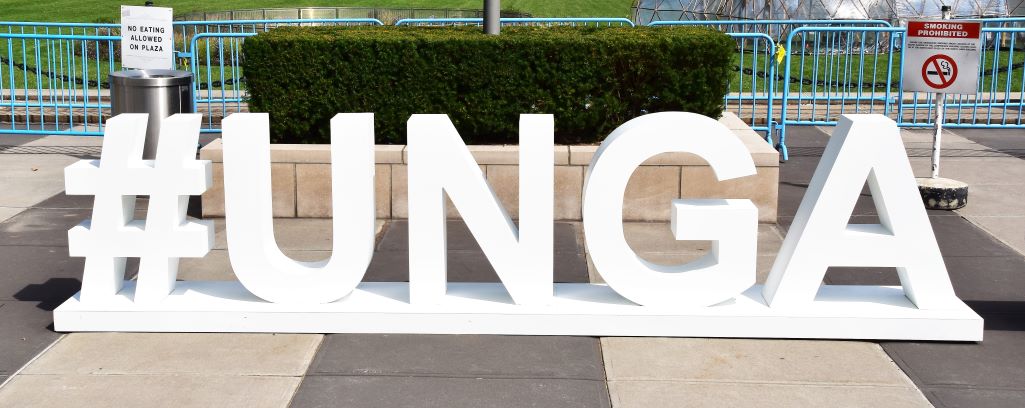
Photo Credit: UNGA sign outside UN building in NYC, Sept 20, 2019, by Diplomatic Security Service. Licensed under Public Domain Mark 1.0
Atrocity Prevention Lens
The UN’s peacekeeping, humanitarian, and conflict-prevention operations are essential for mitigating risk to civilian populations. By monitoring ceasefires, coordinating aid, and enforcing international law, the UN reduces conditions that can escalate into mass atrocities. Analysts view its presence in conflict zones, combined with legal frameworks like the TPNW, as critical for anticipating and preventing large-scale violence.
Legal Framework
UN Charter: Article 1 mandates the promotion of international peace and security, human rights, and economic and social development.
Peacekeeping and International Law: UN missions operate under the principles of consent, impartiality, and non-use of force except in self-defense or mandate enforcement.
Arms Control and Disarmament: Treaties such as the NPT and TPNW establish obligations to prevent proliferation and address humanitarian consequences.
Protection of Civilians: International humanitarian law requires parties to armed conflict to distinguish between civilian and military targets and ensure access to essential aid.
About TGR
The Genocide Report (TGR) publishes analysis and educational resources on conflict, international law, and atrocity prevention. Its work seeks to bridge academic research, field realities, and public understanding of mass violence and civilian protection.