By Lara Kajs
Dispatches from the Field — The Genocide Report
Washington, DC — 1 July 2018
The U.S. withdrawal from the UN Human Rights Council raised critical questions about reform, credibility, and the consequences of disengagement from multilateral human rights institutions.
On 20 June 2018, the United States formally withdrew from the United Nations Human Rights Council (UNHRC). The decision was justified by U.S. officials on the grounds of alleged bias against Israel and concerns regarding the membership of states with poor human rights records.
U.S. Ambassador to the United Nations, Nikki Haley, described the Council as failing to uphold its mandate, citing the inclusion of countries with documented human rights violations. These concerns have been echoed by various observers and reflect longstanding debates about the Council’s structure and membership criteria.
Institutional Criticism and Structural Limits
Criticism of the UNHRC is not new. Questions surrounding membership eligibility and politicization have persisted since the Council’s creation. States with contested human rights records have at times secured seats, raising concerns about the body’s credibility and effectiveness.
At the same time, the Council has played a central role in documenting violations and establishing investigative mechanisms in multiple conflict settings, including Yemen, Syria, and Myanmar. Its commissions of inquiry and reporting functions remain key tools for international accountability and documentation.
The tension between institutional limitations and operational value lies at the center of the debate.
Context: U.S. Human Rights Scrutiny
The withdrawal also occurred amid increased scrutiny of U.S. domestic policies. Then, UN High Commissioner for Human Rights, Zeid Ra’ad Al Hussein, publicly criticized U.S. practices related to family separation at the border, describing them in stark humanitarian terms.
This context complicated the broader narrative, as criticism of international institutions coincided with heightened external critique of U.S. human rights practices.
Attribution and Responsibility
Following the announcement, some administration officials suggested that external actors—including human rights organizations—contributed to the decision to withdraw. However, non-governmental organizations operate independently of state policy and do not direct government decision-making.
Responsibility for the withdrawal rests with the U.S. administration, reflecting a broader policy approach toward multilateral institutions during this period.
The Reform Question
Concerns about the Council’s composition are not without merit. The presence of states accused of serious human rights violations raises legitimate questions about the integrity of membership criteria.
Efforts to strengthen eligibility standards and improve accountability mechanisms have been proposed by various stakeholders. These include reforms aimed at preventing states under investigation for severe violations from holding Council seats.
Such reforms, however, require sustained engagement and coalition-building within the institution.
The Cost of Withdrawal
From a policy perspective, withdrawal carries clear consequences. By leaving the Council, the United States forfeited its voting power and reduced its ability to influence resolutions, shape investigative mandates, and advocate for reforms from within.
While disengagement may serve as a form of protest, it also limits avenues for advancing policy objectives and supporting accountability mechanisms.
Disengagement from imperfect institutions may signal protest—but it also forfeits the ability to shape outcomes from within.”
Atrocity Prevention Lens
The UNHRC plays a role in early warning, documentation, and accountability—key components of atrocity prevention. Reduced engagement by major powers can weaken these functions, particularly in contexts where coordinated international pressure is necessary.
Sustained participation, even within imperfect systems, is often critical to maintaining influence over outcomes that affect civilian protection and human rights enforcement.
Legal Framework
UN Human Rights Council (UNHRC)
An intergovernmental body responsible for promoting and protecting human rights globally, including through investigations and reporting mechanisms.
UN General Assembly Resolution 60/251
Establishes the Council and outlines membership expectations, including the promotion and protection of human rights.
International Human Rights System
A network of treaties, institutions, and mechanisms designed to monitor and enforce human rights standards globally.
Suggested Citation
Kajs, Lara. “U.S. Withdraws from the UN Human Rights Council.” Dispatches from the Field. The Genocide Report, Washington, DC, 1 July 2018.
Photo Credit
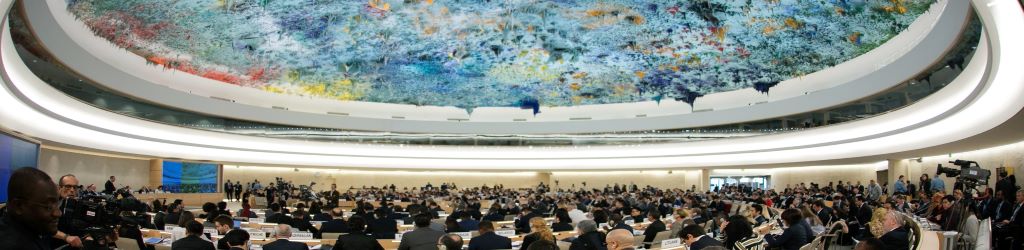
34th Session of the United Nations Human Rights Council by the US Mission to Geneva. Licensed under CC 2.0 license
About TGR
The Genocide Report (TGR) publishes analysis and educational resources on conflict, international law, and atrocity prevention. Its work seeks to bridge academic research, field realities, and public understanding of mass violence and civilian protection.
About the Author
Lara Kajs is the founder and executive director of The Genocide Report, a Washington, DC-based educational nonprofit focused on atrocity prevention and international law. She is the author of several field-based books on conflict, displacement, humanitarian crises, and international humanitarian law, drawing on extensive research and field experience in Yemen, Syria, and Afghanistan. Her writing and public speaking focus on atrocity crimes, forced displacement, the protection of civilians, and the legal frameworks governing armed conflict.