By Lara Kajs
Dispatches from the Field—The Genocide Report
Washington, DC—21 September 2025
Renewed Israeli airstrikes in Gaza, occurring within days of a U.S.-brokered ceasefire, highlight the fragility of negotiated pauses in hostilities and the persistent gap between diplomatic commitments and conditions on the ground. The developments raise urgent questions about compliance with ceasefire terms, the protection of civilians, and the legal obligations governing humanitarian access under international humanitarian law.
Ceasefire Breakdown and Renewed Hostilities
The U.S.-brokered ceasefire between Israel and Hamas came into effect on 10 October, with provisions that included the repositioning of Israeli forces, the release of hostages, and a significant increase in humanitarian aid entering Gaza. The agreement also envisioned the opening of key border crossings, particularly Rafah, to facilitate the delivery of food, fuel, medical supplies, and water.
Despite these commitments, hostilities resumed almost immediately. Within 24 hours of the ceasefire’s implementation, Israeli forces conducted shelling operations in Gaza, resulting in civilian casualties. By 19 October, broader airstrikes were launched following an incident near Rafah in which two Israeli soldiers were killed. Hamas denied responsibility and maintained that it remained committed to the ceasefire.
Israeli officials have similarly stated that the ceasefire remains in effect while asserting the right to respond to perceived violations. Reports from humanitarian organizations indicate multiple alleged breaches, including shelling, arrests, and the use of live fire, underscoring the tenuous nature of the agreement.
Humanitarian Access and Civilian Impact
The renewed strikes have had immediate and significant humanitarian consequences. Airstrikes on 19 October reportedly killed at least 44 individuals and injured many others. Cumulative reports from humanitarian actors indicate dozens of ceasefire violations resulting in additional casualties and injuries.
Humanitarian access remains severely constrained. While initial commitments included the entry of approximately 600 aid trucks per day, current levels have reportedly been reduced by half. Aid organizations have characterized this volume as insufficient to meet the needs of Gaza’s population, which continues to face acute shortages of food, water, fuel, and medical supplies.
The restriction of aid deliveries, particularly when linked to conditions such as the return of hostages’ remains, raises serious legal concerns. Under international humanitarian law, the denial or obstruction of humanitarian assistance to civilian populations may constitute collective punishment, which is prohibited.
Civilians continue to bear the brunt of the crisis. Displaced populations, already living in precarious conditions, remain exposed to ongoing violence. Healthcare infrastructure is degraded, hospitals are only partially operational, and warnings of famine persist as access to essential goods remains limited.
The breakdown of ceasefire commitments in Gaza underscores how fragile agreements, restricted aid, and renewed strikes can rapidly escalate risks for civilians.”
Fragility of Ceasefire Agreements
The current ceasefire follows a pattern observed in previous agreements, including the January 2025 truce, where hostilities continued despite formal commitments. By March 2025, large-scale military operations had resumed, effectively collapsing the agreement.
The present ceasefire includes multiple phases addressing hostages, detainees, troop movements, and reconstruction. However, implementation has been uneven, with key provisions contested or delayed. This has contributed to an environment in which localized incidents risk triggering broader escalation.
Ceasefires in such contexts function less as durable resolutions and more as conditional pauses in violence. Without mechanisms to ensure compliance and accountability, they remain highly vulnerable to breakdown.
Unresolved Political and Strategic Drivers
Underlying drivers of the conflict remain unaddressed. Core issues include governance in Gaza, long-term security arrangements, reconstruction, the status of hostages, and broader questions of Palestinian self-determination.
Both parties face internal and external pressures that complicate adherence to the ceasefire. Israeli leadership must navigate domestic political demands related to security and deterrence, while Hamas faces questions of legitimacy and governance within Gaza.
These dynamics contribute to a cycle in which alleged violations—whether confirmed or disputed—are used to justify retaliatory actions. The result is a feedback loop that undermines ceasefire stability and increases the risk of renewed large-scale conflict.
For mediators, including the United States, Egypt, and Qatar, the inability to ensure implementation of key humanitarian and security provisions risks weakening future diplomatic efforts and diminishing trust in negotiated agreements.
Ceasefire as a Transitional Mechanism
Despite its limitations, a ceasefire remains a critical mechanism for reducing immediate harm to civilian populations. However, it does not constitute a resolution to the conflict. Sustainable peace requires addressing the structural and political conditions that give rise to recurring violence.
Absent progress on these underlying issues, the current ceasefire is likely to remain fragile and subject to repeated disruption. The risk of escalation remains high, particularly in response to high-casualty incidents or perceived violations by either party.
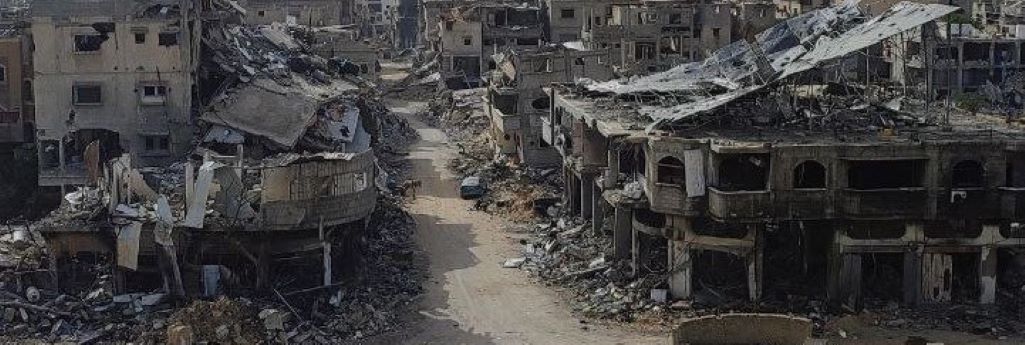
Photo Credit: Israeli destruction in Sikali Street, Khan Yunis, Gaza War 23-25 by Rawanmurad 2025. Licensed under CC BY 4.0
Atrocity Prevention
Breakdowns in ceasefire agreements, particularly in densely populated conflict zones, significantly increase the risk of large-scale civilian harm. The combination of restricted humanitarian access, repeated strikes, and displacement creates conditions associated with escalating atrocity risk. Sustained monitoring, enforcement of civilian protection norms, and accountability for violations are essential to preventing further deterioration and potential mass atrocities.
Legal Frameworks
International humanitarian law governs both the conduct of hostilities and the treatment of civilians during armed conflict.
Ceasefire Obligations
While ceasefires are political agreements rather than codified treaties, parties are expected to adhere to their terms in good faith. Repeated violations undermine their legal and practical effectiveness.
Protection of Civilians
The Geneva Conventions require parties to distinguish between civilian populations and military objectives and prohibit attacks expected to cause disproportionate civilian harm.
Humanitarian Access
Parties to a conflict are obligated to allow and facilitate the rapid and unimpeded passage of humanitarian relief. The deliberate restriction of aid may constitute a violation of international humanitarian law.
Prohibition of Collective Punishment
Measures that penalize civilian populations for actions they did not individually commit, including restricting essential supplies, are prohibited under international law.
About TGR
The Genocide Report (TGR) publishes analysis and educational resources on conflict, international law, and atrocity prevention. Its work seeks to bridge academic research, field realities, and public understanding of mass violence and civilian protection.
About the Author
Lara Kajs is the founder and executive director of The Genocide Report, a Washington, DC-based educational nonprofit focused on atrocity prevention and international law. She is the author of several field-based books on conflict, displacement, humanitarian crises, and international humanitarian law, drawing on extensive research and field experience in Yemen, Syria, and Afghanistan. Her writing and public speaking focus on atrocity crimes, forced displacement, the protection of civilians, and the legal frameworks governing armed conflict.