Dispatches from the Field —The Genocide Report
Washington, DC—2 September 2025
In the context of decades of protracted conflict, repeated violations of international law, and ongoing humanitarian challenges in the occupied Palestinian territories, the UN General Assembly (UNGA) faces renewed calls to recognize the State of Palestine and hold violators accountable. This discussion is situated within broader debates on state sovereignty, international law, and mechanisms for accountability, including the imposition of targeted sanctions to address violations of humanitarian and human rights norms.
Legal and Moral Imperatives for Recognition
Recognition of Palestinian statehood is not merely symbolic; it has significant legal and political implications. Over 130 countries have already recognized Palestine as a sovereign state. Formal UNGA recognition would provide Palestine the standing to participate in international forums, advocate for its rights, and hold violators accountable, thereby reinforcing principles of equality and self-determination under the UN Charter.
Recognition of Palestine is not a symbolic gesture—it is a legal and moral imperative that strengthens accountability and upholds international law.”
Sanctions as a Nonviolent Accountability Tool
Targeted sanctions are a recognized instrument of international diplomacy to address violations of law and incentivize compliance with international norms. They are intended to pressure governments, not populations, and can serve as a means to uphold accountability without resorting to armed conflict.
Assessing Israeli Policies
UN and international legal frameworks, including the Fourth Geneva Convention, prohibit the expansion of settlements in occupied territories and the collective punishment of civilian populations. Blockades, restrictions on movement, and disproportionate military operations have contributed to civilian hardship in Gaza and the West Bank. Targeted sanctions could provide a nonviolent pathway for the international community to respond to these ongoing violations.
Distinguishing State Actions from Civilian Populations
Any accountability measures must differentiate between governmental policies and the people they govern. Israeli civil society includes numerous actors advocating for peace and human rights. Sanctions should target state institutions responsible for unlawful actions while minimizing adverse impacts on civilians.
UN Credibility and Global Governance
For the UN to maintain credibility as an impartial arbiter of peace and justice, consistent enforcement of international law is essential. Recognizing Palestine and addressing violations in a legally grounded manner would reinforce the rules-based international order and signal that systematic violations of human rights and humanitarian law are unacceptable.
Toward a Sustainable Peace
Peace in Israel-Palestine requires both justice and equality. Recognition of Palestinian statehood and accountability measures for violations are steps toward a durable, negotiated solution. Upholding human rights and international law provides the foundation for long-term stability and conflict prevention.
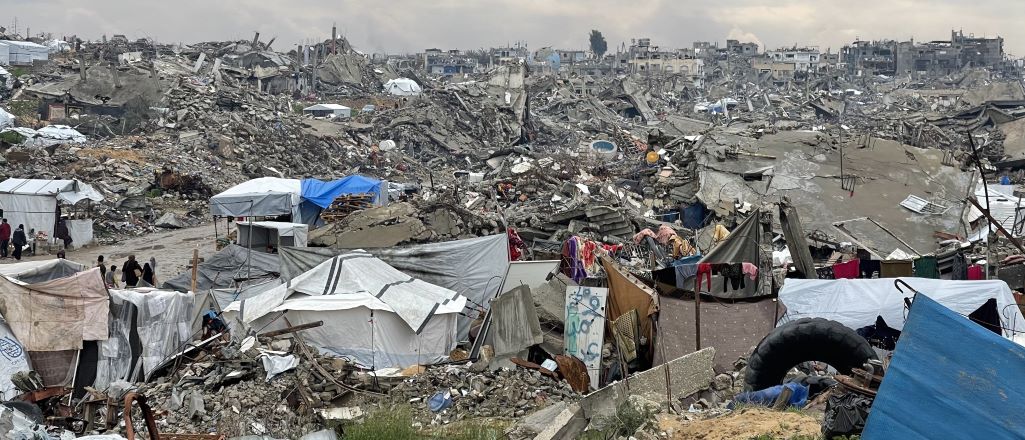
Photo Credit: Ruins of Beit Lehia, Gaza Strip, after Israeli bombardments on 23 February 2025. – Images of war 23-25 from Gaza by Jaber Badwen. Licensed under CC BY-SA 4.0
Atrocity Prevention Lens
The situation in the occupied Palestinian territories reflects multiple structural and proximate risk factors associated with atrocity crimes, including prolonged occupation, restrictions on movement, displacement, and recurring cycles of violence. These conditions contribute to instability and heighten risks to civilian populations, particularly in densely populated areas such as Gaza.
From an atrocity prevention perspective, the absence of accountability mechanisms and consistent enforcement of international law increases the likelihood of continued violations. Recognition of Palestinian statehood and the use of targeted sanctions represent nonviolent tools that may help address systemic grievances, reinforce legal norms, and reduce escalation risks. Sustainable prevention, however, depends on inclusive political solutions, protection of civilian populations, and credible accountability measures that address violations by all parties.
Legal Framework
Right to Self-Determination
International law recognizes the right of peoples to self-determination, as enshrined in the United Nations Charter and reaffirmed in multiple UN resolutions. This principle underpins claims to Palestinian statehood and political sovereignty.
United Nations General Assembly Authority
The UN General Assembly has the authority to recognize states and make recommendations on matters of international peace and security. While its resolutions are not legally binding, they carry significant political and normative weight.
Fourth Geneva Convention
The Fourth Geneva Convention governs the protection of civilians in occupied territories. It prohibits the transfer of an occupying power’s civilian population into occupied territory and forbids collective punishment and measures that harm civilian populations.
Collective Punishment
International humanitarian law explicitly prohibits collective punishment. Policies that impose widespread suffering on civilian populations as a means of coercion may constitute violations of international law.
Sanctions Under International Law
Targeted sanctions are recognized as lawful tools of international diplomacy when used to address violations of international law. They are intended to influence state behavior while minimizing harm to civilian populations.
International Criminal Accountability
Allegations of war crimes or crimes against humanity may fall under the jurisdiction of international legal bodies, including the International Criminal Court. Accountability mechanisms are essential for enforcing international law and deterring future violations.
About TGR
The Genocide Report (TGR) publishes analysis and educational resources on conflict, international law, and atrocity prevention. Its work seeks to bridge academic research, field realities, and public understanding of mass violence and civilian protection.