Lara Kajs
Dispatches from the Field — The Genocide Report
Washington, DC — 11 May 2026
The conflict in Yemen reflects one of the most complex contemporary environments for civilian protection, governance fragmentation, and the application of international humanitarian law. More than a decade after the collapse of centralized authority and the expansion of Houthi control across large portions of the country, Yemen remains shaped by overlapping systems of governance, prolonged armed conflict, external intervention, and severe humanitarian vulnerability.
Unlike conventional interstate conflicts, the Yemeni environment is defined by fragmented authority structures in which multiple actors exercise varying degrees of territorial, political, and military control. The Houthis—also known as Ansar Allah—function simultaneously as an armed non-state actor, de facto governing authority, and participant in regional hostilities. This dual role has significant implications for civilian populations living under their control, as well as for humanitarian operations, accountability mechanisms, and international engagement strategies.
The civilian consequences of this environment extend beyond direct exposure to hostilities. Restrictions on movement, interference in humanitarian operations, economic collapse, and the politicization of governance have contributed to one of the world’s most severe and protracted humanitarian crises.
Fragmented Governance and the Collapse of Central Authority
The Yemeni state has remained deeply fragmented since the escalation of conflict following the Houthi seizure of Sana’a in 2014. What began as an expansion of territorial influence by the Houthis evolved into a broader national conflict involving the internationally recognized Yemeni government, regional actors, local militias, separatist movements, and external military coalitions.
Today, governance in Yemen is divided across competing authorities. The internationally recognized government exercises limited control over portions of the south and east, while the Houthis maintain authority over much of Yemen, including Sana’a and major population centers. Additional areas remain influenced by tribal actors, regional militias, or separatist groups such as the Southern Transitional Council.
This fragmentation has weakened state institutions and significantly reduced the government’s capacity to provide consistent civilian protection, public services, or legal enforcement. In many areas, civilians navigate overlapping systems of authority in which governance is exercised through coercion, military presence, and localized control structures rather than stable national institutions.
The erosion of centralized authority has also complicated diplomatic engagement and accountability efforts. Responsibility for violations, restrictions, or abuses is often diffuse, contested, or politically constrained by the multiplicity of actors involved.
The Houthis as Governing Authority and Armed Actor
The Houthis occupy a hybrid role within Yemen’s conflict environment. While widely designated as a terrorist organization by several governments, including the United States at various points during the conflict, the group simultaneously functions as the de facto governing authority over millions of civilians.
In areas under Houthi control, the group administers security structures, taxation systems, judicial mechanisms, and aspects of public administration. Civil servants, local institutions, and economic systems frequently operate under Houthi oversight or direction. This creates a governance environment in which civilians often depend upon the same authority that also directs military operations and conflict activity.
For civilians, the distinction between governance and armed control is frequently blurred. Access to movement, employment, aid distribution, political expression, and civil society activity may all be shaped by Houthi administrative structures.
This convergence of political authority and military power introduces significant protection concerns. Civilians living under Houthi control may face coercive governance practices, restrictions on dissent, forced recruitment pressures, arbitrary detention, and limitations on humanitarian access. Humanitarian organizations operating in Houthi-controlled areas have repeatedly reported interference in aid delivery, restrictions on operational independence, and constraints on monitoring mechanisms.
At the same time, the presence of an organized governing structure means that international actors cannot entirely separate humanitarian engagement from political realities on the ground. Aid delivery, civilian access, and operational coordination often require some degree of interaction with Houthi authorities, despite the legal and diplomatic constraints associated with terrorist-designation frameworks.
This creates an enduring policy dilemma: how to engage with a de facto governing authority without legitimizing conduct that may violate international norms.
When armed groups govern territory, civilian protection depends not only on the conduct of war, but on the conduct of governance.”
Civilian Exposure and Humanitarian Constraints
Yemen’s civilian population has endured years of compounded vulnerability driven by conflict, economic collapse, infrastructure degradation, food insecurity, and displacement. Millions of Yemenis remain dependent on humanitarian assistance for survival.
The operational environment significantly complicates civilian protection. Airstrikes, shelling, landmines, explosive remnants of war, and armed clashes continue to expose civilians to harm even during periods of reduced hostilities. Damage to healthcare systems, water infrastructure, transportation networks, and food supply chains has intensified humanitarian conditions across the country.
In Houthi-controlled areas, humanitarian operations face additional administrative and political constraints. Aid agencies have reported restrictions on travel, interference with beneficiary selection, limitations on independent assessments, and pressure regarding program implementation. These restrictions affect both the scale and neutrality of humanitarian response efforts.
The result is a layered civilian protection crisis in which vulnerability is shaped not only by direct violence, but also by governance structures that influence access to food, healthcare, movement, and assistance.
The prolonged nature of the conflict has further normalized conditions that would otherwise be understood as emergency failures. Entire generations of civilians have now lived with conditions of instability, deprivation, and fragmented governance.
Regional Conflict Dynamics and External Intervention
The conflict in Yemen cannot be understood solely through domestic political dynamics. Regional intervention has played a defining role in shaping both the conflict trajectory and the civilian consequences that followed.
Following the Houthis’ expansion and seizure of Sana’a, Saudi Arabia led a regional military coalition that launched extensive operations in Yemen beginning in 2015. These operations included airstrikes, blockades, and military support to anti-Houthi forces. The coalition framed its intervention as an effort to restore the internationally recognized government and counter Iranian regional influence.
The Saudi-led intervention became a major driver of civilian harm and infrastructure destruction during the conflict. International organizations and human rights groups documented repeated allegations of indiscriminate strikes, civilian casualties, and damage to protected civilian infrastructure, including hospitals, markets, and residential areas.
At the same time, Iran has been widely accused of providing varying forms of support to the Houthis, including political backing, military assistance, and weapons transfers. The extent of Iranian influence remains debated, but regional actors broadly view the Houthis as part of a wider network of Iranian-aligned armed groups operating across the Middle East.
More recently, Houthi military operations linked to the conflict in Gaza have expanded the regional dimensions of the crisis further. Houthi attacks targeting maritime shipping in the Red Sea and missile launches directed toward Israel have drawn additional international military responses, including strikes by the United States and allied forces.
These developments reinforce Yemen’s position within a broader regional conflict architecture in which civilian protection is increasingly shaped by geopolitical confrontation extending beyond Yemen itself.
Terrorist Designation and International Policy Constraints
The designation of the Houthis as a terrorist organization has had significant implications for diplomacy, humanitarian operations, and international engagement.
While such designations are intended to address security concerns and constrain armed activity, they also introduce operational risks for humanitarian actors working in areas under Houthi control. Financial restrictions, sanctions compliance requirements, and legal uncertainties can complicate aid delivery and discourage commercial or humanitarian engagement necessary for civilian survival.
This creates a persistent tension between counterterrorism policy and humanitarian necessity. Civilians living under Houthi control remain dependent on systems that international actors may be legally or politically constrained from engaging directly.
The challenge is particularly acute in contexts where armed actors also function as governing authorities. Ignoring that governance role does not eliminate its impact on civilians. Instead, it risks reducing the effectiveness of humanitarian and protection strategies intended to mitigate harm.
Accountability and the Enforcement Gap
International humanitarian law applies to all parties to armed conflict, including non-state armed groups. Obligations related to civilian protection, proportionality, distinction, and humane treatment remain legally binding regardless of political recognition or designation status. Yet enforcement remains inconsistent.
Investigations into violations committed by multiple parties to the Yemen conflict—including the Houthis, coalition forces, and affiliated armed groups—have repeatedly identified patterns of civilian harm with limited accountability outcomes. Political considerations, jurisdictional limitations, and the fragmentation of authority continue to constrain enforcement mechanisms.
The absence of consistent accountability has broader implications for atrocity prevention and civilian protection. Where violations occur without meaningful consequence, the deterrent effect of international law weakens, and the harmful practices risk becoming normalized over time.
Implications for Civilian Protection
The conflict in Yemen illustrates the challenges of protecting civilians within fragmented governance environments shaped by hybrid armed actors, regional intervention, and prolonged instability.
Civilian protection in such contexts cannot be addressed solely through military analysis or legal frameworks. It requires understanding how governance functions within conflict environments, how civilians experience authority, and how external political dynamics shape operational realities on the ground.
The Houthis are not solely an armed actor operating outside the state. In large portions of Yemen, they function as the governing authority through which civilians experience both administration and conflict. That reality complicates humanitarian engagement, legal accountability, and international response strategies—but ignoring it does not reduce its impact.
The legal obligations governing armed conflict remain clear. The challenge lies in their consistent application and enforcement within environments where governance, military activity, and civilian life have become deeply intertwined.
Atrocity Prevention Lens
The conflict environment in Yemen presents multiple established indicators associated with elevated atrocity risk, including fragmented governance, prolonged armed conflict, large-scale civilian vulnerability, restricted humanitarian access, and weak accountability mechanisms. The concentration of authority within armed actors exercising both military and administrative control increases risks related to arbitrary detention, coercive governance practices, civilian targeting, and obstruction of humanitarian operations.
The prolonged normalization of civilian harm, combined with inconsistent enforcement of international humanitarian law, contributes to an operational environment in which violations may occur with limited consequence. External intervention, regional proxy dynamics, and the politicization of aid further complicate prevention and protection efforts.
Effective atrocity prevention in Yemen requires sustained monitoring of civilian harm, protection of humanitarian access, support for independent documentation mechanisms, and strengthened international accountability processes. Prevention efforts must also account for the realities of hybrid governance structures in which armed actors function simultaneously as military forces and de facto governing authorities.
Legal Framework
International Humanitarian Law
International humanitarian law, including the Geneva Conventions and customary international law, applies to all parties to the conflict in Yemen, including non-state armed groups such as the Houthis. Legal obligations include the protection of civilians, humane treatment of persons not participating in hostilities, and adherence to the principles of distinction, proportionality, and precaution.
Protection of Civilians
Parties to the conflict are prohibited from intentionally targeting civilians or civilian infrastructure. Attacks expected to cause excessive incidental civilian harm relative to anticipated military advantage may constitute violations of international humanitarian law.
Humanitarian Access
International law requires that humanitarian relief necessary for civilian survival be permitted and facilitated. Restrictions on humanitarian operations, interference with aid delivery, or obstruction of essential assistance may carry legal implications under international humanitarian law.
Accountability Mechanisms
Investigations conducted by international organizations, UN bodies, and independent monitoring groups have documented allegations of violations by multiple parties to the Yemen conflict. However, enforcement remains limited due to political constraints, fragmented jurisdiction, and challenges associated with access and evidence collection.
Suggested Citation
Kajs, Lara. “Governance, Armed Conflict, and Civilian Protection in Yemen.” Dispatches from the Field. The Genocide Report, Washington, DC, 12 May 2026.
Photo Credit
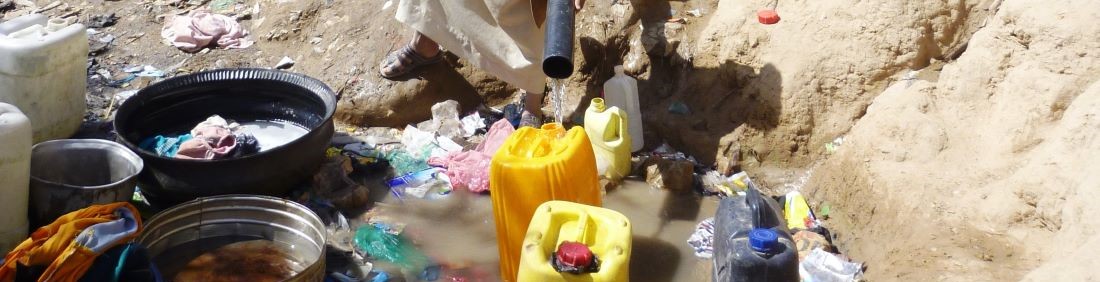
“Yemen Access to Water” by EU Civil Protection and Humanitarian Aid. Licensed under CC BY-SA 2.0
About TGR
The Genocide Report (TGR) publishes analysis and educational resources on conflict, international law, and atrocity prevention. Its work seeks to bridge academic research, field realities, and public understanding of mass violence and civilian protection.
About the Author
Lara Kajs is the founder and executive director of The Genocide Report, a Washington, DC-based educational nonprofit focused on atrocity prevention and international law. She is the author of several field-based books on conflict, displacement, humanitarian crises, and international humanitarian law, drawing on extensive research and field experience in Yemen, Syria, and Afghanistan. Her writing and public speaking focus on atrocity crimes, forced displacement, the protection of civilians, and the legal frameworks governing armed conflict.