Lara Kajs
Dispatches from the Field — The Genocide Report
Washington, DC — 6 May 2026
The protection of civilians in armed conflict is one of the core obligations of international humanitarian law. Yet in contemporary conflict environments, particularly those involving densely populated urban areas and hybrid governance structures, the gap between legal obligation and operational reality continues to widen. The situation in the Gaza Strip illustrates the extent to which established legal frameworks are strained under conditions of sustained hostilities, constrained humanitarian access, and competing military and political objectives.
The conflict environment in Gaza is shaped by high population density, protracted hostilities, and the presence of an armed non-state actor functioning as a governing authority. Together, these conditions create an operational landscape in which the implementation of international humanitarian law remains both essential and heavily scrutinized.
Civilians in Gaza are not only exposed to the immediate effects of hostilities, including airstrikes and ground operations, but are also affected by structural constraints on movement, access to essential services, and humanitarian assistance. These conditions increase vulnerability and complicate efforts to mitigate harm. While legal frameworks governing the conduct of hostilities are well established, their implementation in environments such as Gaza remains inconsistent and subject to competing interpretations.
Operational Environment and Civilian Exposure
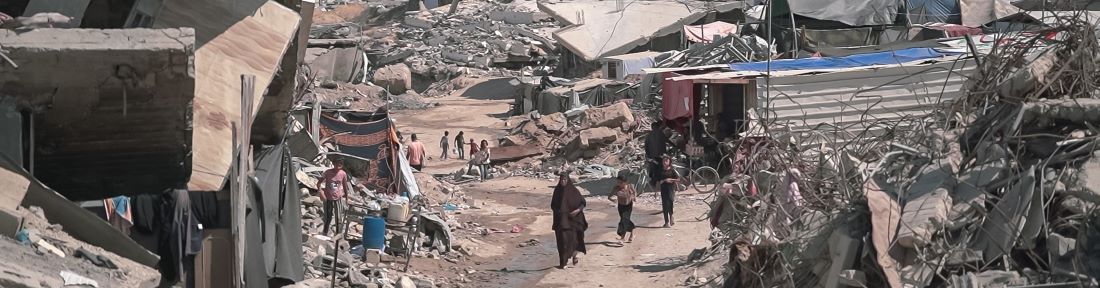
Gaza is among the most densely populated territories in the world. The proximity of civilian infrastructure to areas of military activity significantly increases the risk of incidental harm during hostilities. Residential buildings, schools, medical facilities, and public infrastructure often exist within or near areas designated as military objectives, whether due to the presence of armed actors or to their use for operational purposes.
This spatial overlap complicates the application of the principle of distinction, which requires parties to a conflict to differentiate between civilian objects and military targets. In densely populated environments, even operations intended to target military objectives may carry a high likelihood of civilian impact. The resulting pattern is not only immediate harm but cumulative degradation of civilian infrastructure, contributing to longer-term humanitarian consequences.
Repeated cycles of displacement further intensify these conditions. Civilians are frequently forced to flee within limited geographic space, often without access to stable shelter, sanitation, or medical care. As displacement patterns shift in response to ongoing hostilities, civilian populations remain continuously exposed to risk.
When legal protections exist without consistent enforcement, civilian protection becomes conditional—and civilians bear the cost.”
Hamas as Governing Authority and Armed Actor
Hamas has functioned as the government authority in Gaza since 2007, maintaining administrative control over civil institutions while also operating as an armed actor engaged in hostilities. This dual role introduces additional complexity into the civilian protection environment.
As a governing authority, Hamas is responsible for aspects of civil administration, including internal security and the provision of services. At the same time, its military activities, such as the deployment of fighters, infrastructure, and weapon systems, are integrated into the same geographic space occupied by the civilian population.
This convergence affects both risk and responsibility. Civilians may rely on governing structures for basic services while simultaneously being exposed to the consequences of military activity conducted within their environment. It also obscures the operational landscape for opposing forces, which must assess targets within a context where civilian and military elements are closely interwoven.
The presence of a governing armed actor does not alter the civilian status of the population. However, it does shape the conditions under which civilians experience both governance and conflict, often limiting their ability to avoid exposure to hostilities.
The operational environment in Gaza has become central to international legal debates surrounding the conduct of hostilities. While the integration of military activity within densely populated civilian areas complicates targeting decisions, it does not remove the obligations under international humanitarian law related to distinction, proportionality, and precaution. The scale of civilian harm and destruction in Gaza has therefore intensified scrutiny regarding whether these obligations have been adequately upheld in practice.
Israeli Military Operations and Legal Obligations
Military operations conducted by Israel in Gaza have been framed within the context of security objectives, including the targeting of Hamas infrastructure and capabilities. These operations have included airstrikes, artillery use, and ground incursions, each carrying distinct implications for civilian protection.
Under international humanitarian law, all parties to a conflict are bound by principles including distinction, proportionality, and precaution. The principle of proportionality prohibits attacks in which the expected incidental civilian harm would be excessive in relation to the anticipated military advantage. The principle of precaution requires parties to take feasible steps to minimize harm to civilians.
In practice, the application of these principles in Gaza has been the subject of sustained scrutiny. The density of the environment, combined with the integration of military objectives within civilian areas, intensifies the difficulty of lawful targeting decisions and increases the likelihood of civilian harm. At the same time, questions persist regarding the adequacy of precautionary measures and the assessment of proportionality in specific operations.
Numerous investigations by UN bodies, human rights organizations, and legal scholars have raised serious concerns regarding potential violations of international humanitarian law, including allegations of indiscriminate attacks, collective punishment, starvation as a method of warfare, and conduct potentially amounting to genocidal acts. The cumulative pattern of destruction and civilian harm has led multiple investigators and legal experts to argue that Israeli conduct in Gaza may meet the threshold for war crimes, crimes against humanity, or genocide, though final legal determinations remain pending.
Humanitarian Access and Structural Constraints
Humanitarian conditions in Gaza are shaped not only by active hostilities but also by restrictions on the movement of people and goods. Limitations on access affect the delivery of food, medical supplies, fuel, and other essential resources necessary to sustain civilian life.
Humanitarian organizations operating in the territory face significant operational barriers, including insecurity, logistical blocks, and regulatory restrictions. These challenges limit the scale and consistency of assistance, contributing to the deterioration of living conditions.
Damage to infrastructure further compounds these challenges. Disruptions to water systems, electricity supply, and healthcare capacity reduce the resilience of civilian populations and increase dependence on external aid. In such conditions, even short-term interruptions in assistance can have immediate and severe consequences.
The interaction between active conflict and structural constraints creates a layered humanitarian crisis in which the capacity to respond is consistently outpaced by the scale of need.
Accountability and the Enforcement Gap
Despite the existence of established legal frameworks, accountability for violations of international humanitarian law in Gaza remains limited. Investigations—whether conducted by domestic authorities, international organizations, or independent bodies—often face challenges related to access, evidence collection, and political constraints.
Where findings of potential violations are identified, mechanisms for enforcement are frequently constrained by jurisdictional limitations and geopolitical considerations. This contributes to a broader accountability gap in which patterns of harm may persist without consistent consequence.
The absence of effective accountability mechanisms has implications beyond individual incidents. It affects the overall deterrent effect of international law and shapes the incentives of parties to the conflict. Where enforcement is inconsistent, compliance becomes less predictable, and the risk to civilians increases accordingly.
Implications for Civilian Protection
The situation in Gaza illustrates the challenges of applying established legal norms within complex operational environments characterized by high population density, hybrid governance structures, and ongoing hostilities. Civilian protection in such contexts cannot be understood solely through legal frameworks; it must also account for the conditions that shape how those frameworks are implemented.
Efforts to improve protection outcomes require sustained attention to both immediate and structural factors. This includes monitoring patterns of civilian harm, supporting humanitarian access, and strengthening mechanisms for accountability. It also requires acknowledging the operational realities faced by civilians, who often have limited ability to influence or escape the environments created by ongoing hostilities.
The persistence of these dynamics underscores the gap between legal obligation and practical enforcement. While the principles governing the conduct of hostilities are clear, their consistent application remains a central challenge.
Atrocity Prevention Lens
The Gaza context reflects multiple indicators associated with elevated atrocity risk, including high civilian exposure to hostilities, constrained humanitarian access, and limited accountability mechanisms. The presence of a governing armed actor operating within densely populated areas further increases complexity. Prevention efforts must prioritize early warning indicators, sustained monitoring of civilian harm, and coordinated intervention engagement to reduce risk.
Legal Framework
International Humanitarian Law
The Geneva Conventions and customary international law apply to all parties to the conflict. Core principles include distinction, proportionality, and precaution in the conduct of hostilities.
Protection of Civilians
Civilians are protected from direct attack unless and for such time as they take a direct part in hostilities. Civilian objects, including homes, medical facilities, and infrastructure, are afforded protection under international law.
Accountability Mechanisms
International and domestic legal mechanisms exist to investigate and address violations, though enforcement remains uneven. Strengthening accountability processes remains critical to improving compliance and reducing civilian harm.
Suggested Citation
Kajs, Lara. “Civilian Protection in Gaza: Armed Actors, Urban Warfare, and Legal Constraints.” Dispatches from the Field. The Genocide Report, Washington, DC, 6 May 2026.
Photo Credit
Gaza war 2023-2025 IMG 8182 by Jaber Jehad Badwan. Licensed under CC BY-SA 4.0
About TGR
The Genocide Report (TGR) publishes analysis and educational resources on conflict, international law, and atrocity prevention. Its work seeks to bridge academic research, field realities, and public understanding of mass violence and civilian protection.
About the Author
Lara Kajs is the founder and executive director of The Genocide Report, a Washington, DC-based educational nonprofit focused on atrocity prevention and international law. She is the author of several field-based books on conflict, displacement, humanitarian crises, and international humanitarian law, drawing on extensive research and field experience in Yemen, Syria, and Afghanistan. Her writing and public speaking focus on atrocity crimes, forced displacement, the protection of civilians, and the legal frameworks governing armed conflict.