International law is often associated with treaties, conventions, and formal agreements negotiated between states. Documents such as the United Nations Charter, the Geneva Conventions, and the Genocide Convention provide written legal rules that states voluntarily accept through ratification and accession.
However, not all international law is found in treaties. Many legal obligations arise from another important source known as customary international law. These rules develop through the consistent practice of states and their belief that such practices are legally required.
Customary international law plays a central role in the international legal system. It helps fill gaps where treaties do not exist, applies to states regardless of treaty membership in many circumstances, and provides a foundation for some of the most widely accepted rules governing state behavior.
Understanding customary international law is essential to understanding how international law functions beyond written agreements and why certain legal principles are recognized around the world.
What Is Customary International Law?
Customary international law refers to legal rules that emerge through the general and consistent practice of states accompanied by a belief that such practices are legally obligatory.
Unlike treaties, which are negotiated and adopted through formal processes, customary law develops gradually over time through the actions and conduct of states.
International courts and legal scholars generally recognize two elements that must be present for a rule to become customary international law.
The first element is state practice. States must engage in a pattern of behavior that demonstrates a consistent approach to a particular issue. This practice may be reflected through legislation, military manuals, diplomatic statements, judicial decisions, official policies, and actions taken by governments.
The second element is known by the Latin term opinio juris, meaning a belief that the practice is carried out because it is required by law rather than simply out of convenience, habit, or political preference.
When these two elements exist together, a customary rule may emerge and become part of international law.
How Customary Law Develops
Customary international law evolves through the interaction of states over time.
Governments routinely make decisions regarding diplomacy, armed conflict, maritime activities, human rights, and countless other areas of international relations. As patterns emerge and states increasingly treat certain conduct as legally required, customary norms may develop.
The process is often gradual. Some rules take decades to become widely accepted, while others may emerge more quickly in response to major international events or broad consensus among states.
International organizations, courts, and legal experts frequently analyze state practice to determine whether a customary rule exists. Because customary law is not contained in a single written document, identifying its precise scope sometimes requires careful examination of how states behave and what they say about their legal obligations.
Although the process can be complex, customary law allows international law to adapt to changing circumstances and address issues that may not yet be covered by treaty law.
Examples of Customary International Law
Many important international legal principles are widely recognized as customary international law.
The prohibition against genocide is generally regarded as a customary rule binding on all states. The same is true for prohibitions on slavery, torture, and crimes against humanity.
Many rules governing the conduct of armed conflict have also attained customary status. These include principles requiring distinction between civilians and combatants, prohibiting attacks directed against civilian populations, and protecting medical personnel and humanitarian workers.
Certain aspects of diplomatic immunity, maritime law, and state sovereignty are similarly rooted in customary international law.
Because these rules have achieved broad acceptance, they often apply even in situations where specific treaty obligations may not.
Customary Law and the Geneva Conventions
One of the most significant areas in which customary international law operates is International Humanitarian Law.
The Geneva Conventions establish extensive legal protections during armed conflict. Over time, many of their core principles have become recognized as customary international law through widespread state acceptance and practice.
As a result, important protections for civilians, prisoners of war, and the wounded often remain legally relevant even in situations involving states that have not ratified every treaty provision or protocol.
The International Committee of the Red Cross has conducted extensive research identifying customary rules of International Humanitarian Law, helping governments, courts, and practitioners better understand how customary protections apply during armed conflict.
This relationship between treaty law and customary law demonstrates how international legal norms can reinforce and strengthen one another.
Customary Law and International Courts
International courts frequently rely upon customary international law when interpreting legal disputes and assessing state conduct.
The International Court of Justice regularly examines customary rules when resolving disputes between states. Likewise, international criminal tribunals and the International Criminal Court often consider customary law when evaluating allegations of war crimes, crimes against humanity, and genocide.
Customary law can be particularly important when treaties do not fully address a particular issue or when courts seek to clarify the content of existing legal obligations.
Because customary law reflects broader state practice, it often serves as an important source of legal authority within international judicial proceedings.
Challenges and Debates
Despite its importance, customary international law is not always easy to identify.
Unlike treaties, which are written and publicly available, customary rules must often be inferred from state conduct and legal statements. States may not always behave consistently, and governments sometimes disagree about whether a particular practice reflects a legal obligation.
Questions may also arise regarding how much state practice is necessary to establish a customary rule and whether objections from certain states affect the rule’s applicability.
These debates have led scholars and courts to develop methodologies for evaluating evidence of custom and determining when a rule has achieved sufficient acceptance to be considered legally binding.
While disagreements occasionally occur, customary international law remains one of the most widely recognized sources of international legal authority.
Customary International Law and Atrocity Prevention
Customary international law plays an important role in atrocity prevention because many of the most fundamental protections against mass violence derive from customary legal norms.
The prohibitions against genocide, torture, slavery, and crimes against humanity are widely recognized as customary international law. Core protections for civilians during armed conflict likewise derive from customary humanitarian law.
Because customary rules often apply broadly across the international community, they help establish common standards of conduct and reinforce expectations regarding state behavior.
These shared legal norms provide an important framework for identifying violations, promoting accountability, and strengthening efforts to prevent atrocities before they occur.
By establishing obligations that transcend individual treaties, customary international law helps reinforce the universal nature of fundamental protections for human dignity.
Customary international law is one of the foundational sources of the international legal system. Developed through state practice and a belief in legal obligation, customary rules help shape how states interact, how conflicts are regulated, and how fundamental rights are protected.
Although less visible than treaties and conventions, customary international law influences many of the legal principles that govern international relations today. From the prohibition of genocide and torture to protections for civilians during armed conflict, customary norms play a critical role in promoting accountability, stability, and respect for human dignity.
Understanding customary international law provides valuable insight into how international law develops, evolves, and operates beyond the text of formal agreements.
Related International Law Resources
• United Nations Charter
• Statute of the International Court of Justice (Article 38)
• Geneva Conventions
• Rome Statute
• Universal Declaration of Human Rights
Photo Credit
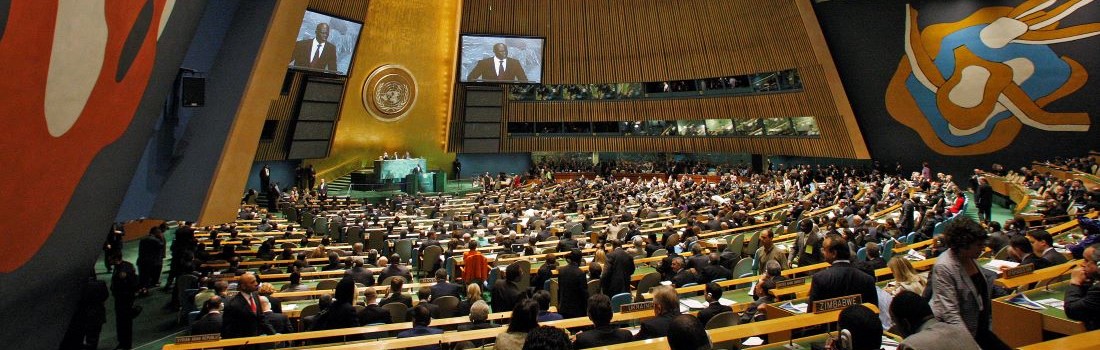
United Nations General Assembly Summit on Climate by United Nations Photo. Licensed under CC BY-NC-ND 2.0.