Lara Kajs
Dispatches from the Field — The Genocide Report
Washington, DC — 16 November 2026
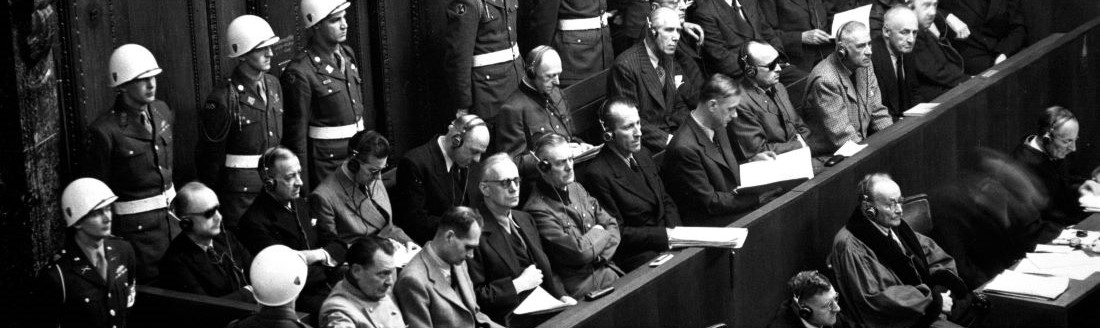
On 20 November 1945, in a courtroom in the German city of Nuremberg, twenty-one defendants sat before the International Military Tribunal (IMT). They were among the most senior surviving political, military, and economic leaders of Nazi Germany. The proceedings were not intended as retribution. Rather, they presented a question with consequences far beyond the immediate aftermath of the Second World War: could those responsible for aggressive war and mass atrocities be held individually accountable before an international court?
The Nuremberg Trial did not end atrocity or establish a permanent system of international criminal justice. Its significance was more fundamental. It helped establish that individuals, including senior government officials and military leaders, could be held criminally responsible under international law. It also demonstrated the importance of documentary evidence, public proceedings, and legal accountability in confronting mass violence.
Eighty-one years later, the principles associated with Nuremberg remain central to international criminal law and the pursuit of accountability. Nearly every modern tool of international criminal justice, from the Rwanda and Yugoslavia tribunals to the International Criminal Court, traces its lineage to that courtroom.
Why a Trial?
As the Second World War ended, the Allied powers faced the question of how to address the crimes committed by Nazi Germany’s leadership. Some officials favored summary execution of senior Nazi figures. Others, particularly within the United States government, argued that the defendants should face a public judicial proceeding.
U.S. Supreme Court Justice Robert H. Jackson became the principal architect of the American effort to establish an international tribunal. His argument was both legal and historical. A trial would require the prosecution to present evidence, allow the accused to respond, and establish a documented record of the crimes. It would also affirm that political authority and military command did not place individuals beyond the reach of law.
On 8 August 1945, the United States, the United Kingdom, the Soviet Union, and the Provisional Government of the French Republic signed the London Agreement. It adopted the Charter of the International Military Tribunal. The Charter established the Tribunal’s jurisdiction, defined the crimes it could prosecute, and provided the legal framework for the proceedings.
The decision to pursue a trial was consequential. Rather than relying solely on the power of the victorious states to punish defeated leaders, the Allies established a judicial process intended to articulate legal responsibility for crimes committed on an unprecedented scale.
The Charges and the Legal Framework
The London Charter established three categories of crimes within the Tribunal’s jurisdiction: crimes of peace, war crimes, and crimes against humanity. The indictment brought four counts against the defendants, separating conspiracy from the substantive charges.
Crimes against peace concerned planning, preparing, initiating, and waging wars of aggression, as well as participating in a common plan or conspiracy to carry them out. War crimes encompassed violations of the laws and customs of war, including the murder or ill-treatment of prisoners of war, the killing of civilians in occupied territories, and the plunder or destruction of property not justified by military necessity.
Crimes against humanity covered murder, extermination, enslavement, deportation, and persecution on political, racial, or religious grounds when committed against civilian populations. The Charter’s definition, however, required a connection to other crimes within the Tribunal’s jurisdiction, particularly crimes against peace or war crimes.
The limitation was significant. The Tribunal could address Nazi persecution and mass violence against civilians, including German nationals. Still, crimes against humanity under the Charter were not yet an autonomous category of international crime independent of armed conflict. Later international legal instruments would remove that connection.
The Tribunal’s jurisdiction also marked an important development in international law: conduct committed by a government against its own population could become a matter of international criminal responsibility. State sovereignty and domestic authority could not automatically shield individuals from prosecution for international crimes.
The Trial and the Use of Evidence
The proceedings lasted nearly a year. Judges and prosecutors from the four Allied powers participated, and the trial operated in English, French, Russian, and German. Its extensive use of simultaneous interpretation was a major practical development in the conduct of multilingual international proceedings.
The prosecution relied heavily on documentary evidence produced by the Nazi regime itself. Orders, memoranda, administrative records, meeting minutes, and official correspondence helped establish how the regime organized and implemented its policies. Film footage and other visual evidence were also presented. The prosecution sought to demonstrate the scale and systematic character of the crimes through records generated by the institutions and officials responsible for them.
This approach carried significance beyond the courtroom. Testimony from survivors and witnesses was essential, but the perpetrators’ own records also helped establish how policies were developed, communicated, and carried out. Documentation could reveal patterns of conduct, connect decisions to institutions, and help establish individual responsibility.
The evidentiary approach at Nuremberg remains relevant to atrocity investigations today. As discussed in TGR’s Documenting Atrocities: Why Evidence Matters in Prevention and Accountability, reliable documentation is essential not only to reconstructing what happened, but also to establishing patterns, preserving evidence, and supporting future accountability.
The Verdicts and Sentences
Twenty-four Nazi officials were indicted. Twenty-one defendants appeared in court. Robert Ley died by suicide before the proceedings began, and industrialist Gustav Krupp was excluded because of his medical condition. The Tribunal tried Martin Bormann, whose whereabouts were unknown, in absentia.
The Tribunal delivered its judgments on 30 September and 1 October 1946. The Tribunal convicted nineteen defendants and acquitted three. Twelve defendants received death sentences, including the missing Bormann. Hermann Göring died by suicide shortly before the scheduled executions. Three were sentenced to life imprisonment, and four received prison terms ranging from ten to twenty years. On 16 October 1946, ten defendants were hanged.
The Tribunal also considered the criminal responsibility of several Nazi organizations and institutions. It declared the SS, the Gestapo, the SD, and the Leadership Corps of the Nazi Party criminal organizations, subject to limitations set out in its judgment. This aspect of the proceedings was significant, although the Tribunal’s lasting influence on international criminal law rested more heavily on the principle of individual responsibility.
The Principles That Endured
Nuremberg’s most consequential legacy was not the punishment imposed on individual defendants, but the legal principles affirmed through the proceedings. The Tribunal rejected the proposition that international law imposed obligations only on states. Its judgment stated that individuals, not abstract entities, can be held responsible for crimes committed under international law. This principle helped establish individual criminal responsibility as a foundation of modern international criminal law.
The Tribunal also rejected official position as an automatic defense. A head of state, government minister, or senior military official could not claim immunity from criminal responsibility simply because of the office held. Authority did not remove individual accountability.
The treatment of superior orders was similarly important. The Charter provided that acting pursuant to an order from a government or superior did not automatically relieve a defendant of responsibility; however, it could be considered in mitigation of punishment where the interests of justice required. The principle established that obedience to authority did not, by itself, excuse participation in international crimes.
The Tribunal further affirmed that individuals could be held responsible under international law even when domestic law did not criminalize the conduct in question. International obligations could not be displaced simply by invoking national legislation or official policy. These principles challenged the assumption that state authority could shield those responsible for mass violence. They also helped establish the legal basis for prosecuting individuals whose actions were carried out through government institutions, military structures, or organized systems of persecution.
In December 1946, the United Nations General Assembly unanimously adopted Resolution 95(I), affirming the principles of international law recognized in the Charter and judgment of the Nuremberg Tribunal. In 1950, the International Law Commission formulated the principles, commonly known as the Nuremberg Principles, and submitted them to the General Assembly. They were not a separate treaty, but their influence on the development of international criminal law was substantial.
The development of the Genocide Convention was not simply an extension of the Nuremberg proceedings. It represented a separate legal response to the destruction of protected groups and established a framework that continues to govern the international prohibition of genocide.
“The Tribunal’s most consequential legacy was the principle that no individual, regardless of position or authority, stands beyond the reach of international law.”
Lara Kajs — The Genocide Report
Beyond the Main Trial
The International Military Tribunal was only the first of the Nuremberg proceedings. Between 1946 and 1949, the United States conducted twelve additional trials under Allied Control Council Law No. 10. These proceedings addressed the responsibility of doctors, judges, industrialists, military commanders, and members of the SS and the Einsatzgruppen.
The Doctors’ Trial resulted in the formulation of the Nuremberg Code, a set of principles addressing the ethical conduct of human experimentation. Its emphasis on voluntary consent and the protection of research subjects continues to influence medical research ethics.
Separate proceedings in Tokyo brought senior Japanese wartime leaders before the International Military Tribunal for the Far East. Although distinct from the Nuremberg Tribunal, the Tokyo proceedings reflected the broader postwar effort to establish individual criminal responsibility for international crimes.
Together, these proceedings contributed to the development of international criminal law, although their jurisdiction, procedures, and treatment of defendants differed.
The Criticisms and Limits of Nuremberg
A serious assessment of Nuremberg must also address its limitations. The Tribunal was established and conducted by the victorious Allied powers. Its judges and prosecutors represented those states, while Allied conduct during the war was not subjected to comparable scrutiny.
This asymmetry became central to criticism of Nuremberg as an example of victors’ justice. The Soviet Union’s responsibility for the Katyn massacre, in which thousands of Polish officers and other prisoners were murdered, was not examined by the Tribunal. Allied strategic bombing campaigns that caused extensive civilian casualties were also outside the proceedings. The absence of equivalent scrutiny raised questions about selective accountability and the consistency with which international law was applied.
The defendants also challenged the retroactive application of criminal law, invoking the principle mullum crimen sine lege: there can be no crime or punishment without a pre-existing legal basis. The argument was particularly significant in relation to crimes against peace and the application of international criminal responsibility to individuals. The Tribunal rejected the defense, reasoning that the relevant conduct violated established international obligations and that individuals could be held responsible for breaches of international law.
Another important limitation concerned crimes against humanity. Because the Charter required a connection to war crimes or crimes against peace, the Tribunal’s jurisdiction did not extend independently to all persecution and atrocities committed before the war. This left significant aspects of Nazi persecution outside the full reach of the proceedings.
Nuremberg was also a temporary tribunal created for a specific historical purpose. It did not establish a permanent international court with continuing jurisdiction. Its legacy therefore depended on the subsequent development of legal standards, institutions, and mechanisms capable of applying those principles beyond the immediate postwar period.
These criticisms do not erase the Tribunal’s legal significance. They demonstrate why accountability must be consistent, impartial, and grounded in established legal standards if international justice is to command legitimacy.
From Nuremberg to Permanent International Justice
The creation of a permanent international criminal court did not follow immediately from Nuremberg. Although the United Nations pursued work on the codification and development of international criminal law after the war, political divisions during the Cold War stalled progress toward a permanent institution.
Momentum returned in the 1990s. The United Nations Security Council established the International Criminal Tribunal for the former Yugoslavia in 1993 and the International Criminal Tribunal for Rwanda in 1994. Both tribunals prosecuted individuals for genocide, crimes against humanity, and war crimes, further developing the principles of individual criminal responsibility established at Nuremberg.
In 1998, states adopted the Rome Statute, creating the legal foundation for the International Criminal Court. The Court began operating in 2002 as a permanent institution with jurisdiction over genocide, crimes against humanity, war crimes, and, under specific conditions, the crime of aggression.
National courts have also played an increasingly important role in prosecuting international crimes, including through the exercise of universal jurisdiction where applicable. These developments reflect the broader evolution of international criminal justice from a series of postwar and ad hoc tribunals toward a more enduring, though still incomplete, system of accountability.
Nuremberg did not create every institution or legal mechanism that followed. It helped establish the principles and demonstrate the possibility of prosecuting individuals for crimes under international law, providing a foundation for later developments.
Atrocity Prevention Lens
Nuremberg established that accountability for international crimes is not solely a matter of responding to atrocities after they occur; it is also central to preventing their recurrence. The principle that individuals can be held responsible regardless of official position, military rank, or superior orders challenges the impunity that allows mass violence to be organized and carried out through state institutions. Effective atrocity prevention therefore requires credible investigations, evidence preservation, impartial prosecution, and consistent application of international law. When political influence or selective enforcement shields perpetrators from accountability, it weakens the deterrent effect of international criminal law and reinforces conditions that allow future violations. Nuremberg’s enduring lesson is that the rule of law must apply to those who exercise power as well as those subject to it.
Legal Framework
Individual Criminal Responsibility
International criminal law recognizes that individuals may be held directly responsible for genocide, crimes against humanity, war crimes, and the crime of aggression. Criminal responsibility may attach to those who order, plan, instigate, commit, or otherwise contribute to the commission of these crimes, subject to the applicable legal requirements. Official position does not automatically exempt an individual from responsibility, and the principle of individual accountability applies to civilian and military leaders alike.
Superior Orders and Command Responsibility
An order from a government or superior does not, by itself, relieve an individual of criminal responsibility for an international crime. The legal effect of superior orders depends on the applicable statute and circumstances, but obedience to authority is not a blanket defense. International law also recognizes command responsibility where a military commander or other superior knew, or had reason to know, that subordinates were committing or were about to commit crimes and failed to take necessary and reasonable measures to prevent or punish them, as required by the applicable legal standard.
Crimes Against Humanity
Crimes against humanity encompass specified acts, including murder, extermination, enslavement, deportation, imprisonment, torture, persecution, and other inhumane acts, when committed as part of a widespread or systematic attack directed against a civilian population, with the requisite knowledge. Unlike the original Nuremberg Charter, contemporary international criminal law does not require crimes against humanity to be connected to an armed conflict.
War Crimes
War crimes are serious violations of international humanitarian law that give rise to individual criminal responsibility. They include grave breaches of the Geneva Conventions and other serious violations of the laws and customs of armed conflict. The obligation to respect and ensure respect for international humanitarian law applies to parties to an armed conflict, while individuals may be prosecuted for war crimes when the applicable legal elements are established.
Genocide Convention
The Genocide Convention of 1948 established genocide as an international crime. It defines genocide through specified prohibited acts committed with the intent to destroy, in whole or in part, a national, ethnical, racial, or religious group. The Convention requires states to prevent and punish genocide, while international criminal law provides for individual responsibility. Genocide is not defined solely by the scale of violence; the specific intent to destroy a protected group, in whole or in part, is a central element of the crime.
The Nuremberg Principles
Affirmed by the United Nations General Assembly in Resolution 95(I) on 11 December 1946 and formulated by the International Law Commission in 1960, the Nuremberg Principles contributed to the development of a legal framework in which international crimes could be prosecuted before national and international courts.
Rome Statute of the International Criminal Court
The Rome Statute of the International Criminal Court provides jurisdiction over genocide, crimes against humanity, war crimes, and the crime of aggression. It codifies individual criminal responsibility and addresses the responsibility of commanders and other superiors, complementing national jurisdiction through the principle of complementarity.
Suggested Citation
Kajs, Lara. “Nuremberg: How One Trial Changed International Law.” Dispatches from the Field. The Genocide Report. Washington, DC, 16 November 2026.
Photo Credit
Public Domain – Nuremberg Trials 1945-46 (HD-SN-99-02955 – DOD/NARA by Ping News. Licensed under Public Domain Mark 1.0
About TGR
The Genocide Report (TGR) publishes analysis and educational resources on conflict, international law, and atrocity prevention. Its work seeks to bridge academic research, field realities, and public understanding of mass violence and civilian protection.
About the Author
Lara Kajs is the founder and executive director of The Genocide Report, a Washington, DC-based educational nonprofit focused on atrocity prevention and international law. She is the author of several field-based books on conflict, displacement, humanitarian crises, and international humanitarian law, drawing on extensive research and field experience in Yemen, Syria, and Afghanistan. Her writing and public speaking focus on atrocity crimes, forced displacement, the protection of civilians, and the legal frameworks governing armed conflict.