Lara Kajs
Dispatches from the Field — The Genocide Report
Washington, DC — 8 October 2026
After more than a decade of conflict, Yemen is again experiencing a major escalation of armed violence. Fighting intensified along the country’s western coast in September, reversing much of the relative calm that followed the United Nations-mediated truce of 2022. By September 22, UNHCR estimated that approximately 128,000 people had been newly displaced inside Yemen, adding to the 5.2 million people already living in internal displacement. Thousands more crossed the Bab el-Mandeb Strait toward Djibouti. The immediate humanitarian emergency is severe, but the broader significance is equally important: renewed displacement indicates that conditions for civilian protection are deteriorating once again.
A Fragile Calm Gives Way to Renewed Fighting
Yemen’s present crisis is rooted in a conflict that escalated dramatically in 2014, when the Houthi movement (Ansar Allah) and allied forces seized control of Sana’a and expanded their territorial control. In March 2015, a Saudi-led coalition intervened militarily at the request of the internationally recognized government of President Abd Rabbah Mansour Hadi. The conflict produced extensive civilian casualties, infrastructure destruction, and a prolonged humanitarian emergency.
The UN-mediated truce that began in April 2022 demonstrated the civilian benefits of reducing hostilities. The agreement halted offensive ground, air, and maritime operations, facilitated fuel imports through Hudaydah, and permitted commercial flights from Sana’a. Although the truce formally expired in October 2022, large-scale fighting did not immediately resume. The resulting reduction in violence reduced displacement and improved civilian movement.
However, the truce was not a comprehensive peace agreement. Political divisions remained unresolved, while Yemen’s institutions and economy remained deeply weakened. The September 2026 escalation therefore represents the reactivation of an unresolved conflict rather than the emergence of an entirely new one.
On September 10, UN Special Envoy Hans Grundberg told the Security Council that the risk of a return to large-scale conflict had become a “harsh reality.” Fighting intensified across multiple front lines, particularly along the western coast, before spreading to additional areas including Taiz, Lahj, and Marib.
The western coast has significance beyond its military position. It contains population centers, transportation routes, ports, and approaches to the Bab el-Mandeb Strait, a major international maritime chokepoint. Fighting in these areas can therefore affect civilian movement and humanitarian access while creating broader regional and economic consequences.
Displacement as an Indicator of Civilian Insecurity
The scale of the new displacement is particularly significant because Yemen already has one of the world’s largest protracted displacement crises. The UN’s 2026 Humanitarian Needs and Response Plan estimated that 22.3 million people require humanitarian assistance and protection services, including approximately 5.2 million internally displaced people. The scale of need means that newly displaced families are entering an environment in which household resources, infrastructure, and institutional capacity are already severely strained.
UNHCR reported approximately 128,000 newly displaced people within Yemen by September 22. Thousands more crossed the Bab el-Mandeb Strait toward Djibouti. For many families, the movement represents another disruption to livelihoods, housing, documentation, education, and community networks.
Repeated displacement is particularly consequential. Families that have already lost their homes, employment, property, or social support have fewer resources with which to absorb another period of instability. Displacement can therefore become cumulative: each new movement reduces the capacity of households to recover before the next disruption occurs.
For that reason, displacement should be read not only as a humanitarian outcome but also as a protection indicator. Rapid population movement away from areas of fighting can signal declining civilian security, while repeated displacement indicates that civilians are unable to establish stable conditions in which recovery can occur.
Renewed displacement is not simply a consequence of renewed fighting. It is an indicator that civilian security is deteriorating and that the conditions supporting Yemen’s fragile recovery were never consolidated into a durable peace.”
A Health System Under Severe Strain
The escalation is also placing additional pressure on a health system already operating with limited capacity. The WHO reported 3,672 casualties between August 6 and September 18, including 674 deaths and 2,998 injuries. Approximately 60 percent of assessed health service delivery units were fully functioning, while only about 6 percent of assessed facilities offered full-service trauma care.
The challenge is not limited to treating new conflict injuries. Limited staffing, medicines, equipment, financing, and referral capacity constrain the ability of health facilities to absorb additional trauma cases while maintaining essential routine services. Displacement further increases demand for maternal and child health care, treatment of chronic conditions, and other basic services.
At the same time, damaged infrastructure, disrupted transportation, and restricted humanitarian access can prevent civilians from reaching functioning facilities in the first place. The WHO has described Yemen as facing overlapping pressures from conflict, economic deterioration, disease outbreaks, and climate-related shocks.
The result is a narrowing margin of resilience. When a health system is already operating below full capacity, renewed violence can transform individual disruptions into broader failures of civilian access to essential care.
Crossing the Bab el-Mandeb
The renewed violence has also pushed some Yemenis beyond the country’s borders. By September 17, UNHCR estimated that nearly 2,935 people had arrived in Djibouti after crossing the Gulf of Aden, approximately 60 percent of whom were women and children. The arrivals were concentrated around Obock, where humanitarian organizations and Djiboutian authorities were providing essential assistance and protection services.
Cross-border movement is significant because it demonstrates that some civilians no longer consider remaining in affected areas a viable option. The journey itself can create additional risks, particularly when people lack safe transportation, reliable information, or access to adequate assistance upon arrival.
Protection obligations do not end at an international border. People fleeing armed conflict may require access to asylum procedures, protection against forced return, shelter, medical assistance, and other essential services. The principle of non-refoulement prohibits returning refugees or asylum seekers to places where they would face persecution or other serious harm.
For Djibouti and other receiving countries, the immediate challenge is therefore both humanitarian and legal: responding to an influx while ensuring that people fleeing conflict are treated as persons requiring protection rather than solely as a migration-management concern.
Humanitarian Assistance Cannot Substitute for Civilian Protection
Humanitarian organizations can provide food, shelter, medicine, water, and emergency protection services, but humanitarian assistance cannot create the security conditions necessary to prevent displacement.
Yemen’s humanitarian response is already constrained by funding shortages, restricted access, institutional fragmentation, and deteriorating basic services. As fighting expands, damaged roads, disrupted referral routes, insecurity around displacement sites, and restrictions on humanitarian movement can further limit access to populations in need. The WHO has reported that changes along the western coast have disrupted referral routes and made some areas with high health needs increasingly difficult to reach.
This distinction is fundamental to civilian protection. Humanitarian assistance can reduce the consequences of conflict, but it cannot substitute for compliance with international humanitarian law, guarantee safe humanitarian access, or resolve the political conditions that repeatedly expose civilians to violence and displacement.
From Temporary Calm to Durable Prevention
The 2022 truce demonstrated that reducing hostilities can produce measurable benefits for civilians. Its failure to develop into a comprehensive political settlement also demonstrates the limits of temporary de-escalation when the underlying conflict remains unresolved.
A cessation of hostilities remains an immediate priority, but it should be treated as an opening for sustained political negotiations rather than as the endpoint of international engagement. The UN Special Envoy has continued to emphasize the need to preserve a pathway toward a negotiated settlement. The renewed fighting makes the task more difficult while demonstrating the consequences of allowing unresolved political disputes to return to the battlefield.
A durable approach requires sustained diplomacy alongside civilian protection, humanitarian access, monitoring of displacement and civilian harm, and accountability for serious violations. Displaced Yemenis must also have a meaningful role in decisions concerning return, local integration, and other durable solutions.
The objective cannot simply be to reproduce the relative calm that followed the 2022 truce. The greater challenge is converting periods of reduced violence into political arrangements and institutions capable of sustaining civilian security.
A Crisis That Should Be Read as a Warning
The September escalation demonstrates how quickly civilian vulnerability can increase when renewed fighting meets already weakened institutions and protracted displacement.
The most important warning signs are visible in the pattern itself: large-scale new displacement, declining health-system capacity, restricted humanitarian access, and growing cross-border movement. Taken together, these indicators suggest a deterioration in the environment necessary for civilian protection.
Atrocity prevention depends in part on recognizing such patterns before serious violations become widespread or systematic. Yemen therefore illustrates why prevention cannot begin only after mass atrocities occur. It requires sustained attention to civilian harm, displacement, institutional deterioration, and impunity while there is still an opportunity to interrupt escalation.
Atrocity Prevention Lens
Atrocity risk can emerge through the cumulative deterioration of civilian protection rather than through a single catastrophic event. Renewed displacement, civilian casualties, disrupted health services, restricted humanitarian access, and increasing cross-border flight are indicators of a protection environment under strain. When these conditions persist or intensify, civilian vulnerability can become entrenched, and the capacity of communities and institutions to absorb further violence can diminish. Atrocity prevention therefore requires sustained attention to these early indicators, alongside efforts to reduce hostilities, preserve humanitarian access, strengthen accountability, and address the political conditions driving recurrent conflict and displacement.
Legal Framework
Geneva Conventions and Additional Protocols
The four Geneva Conventions of 1949 and their Additional Protocols form the foundation of international humanitarian law governing the conduct of armed conflict and the protection of persons affected by war. These rules establish protections for civilians and other persons not, or no longer, taking part in hostilities and require parties to distinguish between civilians and military objectives. They also protect wounded and sick persons, medical personnel and facilities, and humanitarian relief operations. The protections apply regardless of the identity or political position of the parties to a conflict.
Customary International Humanitarian Law
Customary international humanitarian law establishes rules that bind parties to armed conflict independently of whether particular treaty provisions apply. Among its core principles are distinction, proportionality, precaution in attack, and the protection of civilians from the dangers arising from military operations. Customary rules also prohibit directing attacks against civilians and provide protections concerning the treatment and movement of civilian populations. These standards apply across both international and non-international armed conflicts.
Protection of Civilians and Forced Displacement
International humanitarian law protects civilians from direct attack and from violence arising from military operations. The forced displacement of civilians is prohibited except under narrowly defined circumstances, including when the security of civilians or imperative military reasons require evacuation. Where displacement is permitted, parties must take measures to ensure adequate conditions of shelter, health, safety, hygiene, and nutrition. These protections reflect the broader principle that civilians must not bear the consequences of military operations beyond what international law permits.
Rome Statute and International Criminal Law
The Rome Statute establishes the legal framework for individual criminal responsibility for genocide, crimes against humanity, war crimes, and crimes of aggression, subject to the jurisdictional requirements of the International Criminal Court. International criminal law recognizes that serious violations of the laws and customs applicable in armed conflict can give rise to individual responsibility. Accountability may extend to those who order, facilitate, or otherwise bear legally recognized responsibility for international crimes, including under applicable principles of command responsibility.
Refugee Law and Non-Refoulement
International refugee law establishes protections for people who cross international borders because they cannot safely remain in their countries of origin. The 1951 Refugee Convention and its 1967 Protocol provide the principal international framework for refugee protection, including the principle of non-refoulement. Under that principle, refugees and asylum seekers must not be returned to a territory where they face persecution or other serious harm. Non-refoulement also derives from international human rights law and customary international law and therefore remains relevant beyond the specific application of the Refugee Convention.
Rule of Law
International humanitarian and refugee protections are legal obligations rather than discretionary humanitarian standards. Compliance does not depend upon the political identity of a party, the legitimacy of its stated objectives, or the conduct of an opposing party. The consistent application of these standards is essential to civilian protection, accountability, and the credibility of the international legal order. Where serious violations are met with inconsistent enforcement or prolonged impunity, the protective functions of international law are weakened.
Suggested Citation
Kajs, Lara. “Yemen: Renewed Fighting, Displacement, and the Return of Civilian Risk.” Dispatches from the Field. The Genocide Report, Washington, DC, 8 October 2026.
Photo Credit
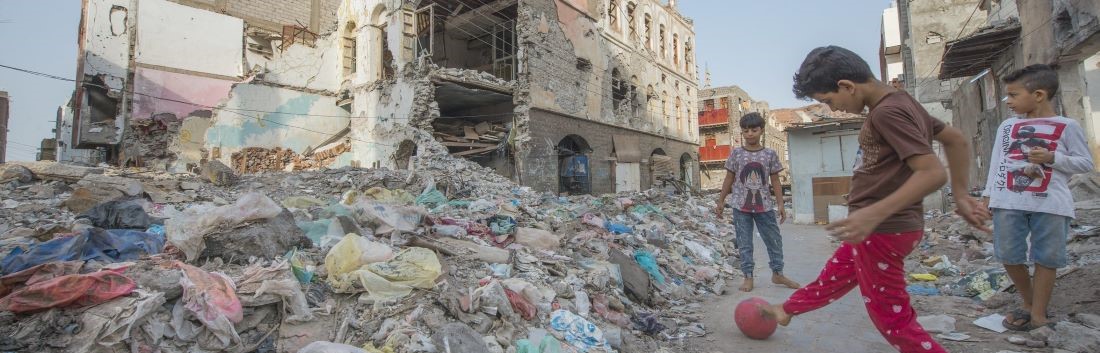
Humanitarian crisis in Yemen by EU Civil Protection and Humanitarian Aid. Licensed under CC BY NC-ND 2.0
About TGR
The Genocide Report (TGR) publishes analysis and educational resources on conflict, international law, and atrocity prevention. Its work seeks to bridge academic research, field realities, and public understanding of mass violence and civilian protection.
About the Author
Lara Kajs is the founder and executive director of The Genocide Report, a Washington, DC-based educational nonprofit focused on atrocity prevention and international law. She is the author of several field-based books on conflict, displacement, humanitarian crises, and international humanitarian law, drawing on extensive research and field experience in Yemen, Syria, and Afghanistan. Her writing and public speaking focus on atrocity crimes, forced displacement, the protection of civilians, and the legal frameworks governing armed conflict.